Bookkeeping Guide for Canadian Small Businesses (2026)
Everything you need to know about bookkeeping as a Canadian small business — tips, software, cleanup, double-entry basics, and how to stay organized year-round.
 Eric Tech·Mar 18, 2026·6 min read·
Why Bookkeeping Matters for Canadian Businesses
Good bookkeeping is not about being organized for its own sake. It directly affects how much tax you pay, how quickly you can file, and whether you survive a CRA audit.
Canadian self-employed workers who maintain proper records claim an average of $2,000-5,000 more in deductions annually compared to those who reconstruct expenses at year-end. At a 30% marginal tax rate, that is $600-1,500 in real savings per year.
This hub page connects our bookkeeping guides into one organized resource. Whether you are setting up bookkeeping for the first time or cleaning up years of disorganized records, start here.
Getting Started
What Is Bookkeeping? Why You No Longer Need an Accountant for It
What bookkeeping actually means, what a bookkeeper does, and why AI tools now handle the work that used to cost $400-$1,200/month. Start here if you have zero accounting knowledge.
How to Set Up Bookkeeping for a New Business
Step-by-step checklist for setting up bookkeeping from scratch — bank accounts, fiscal year, cash vs accrual, expense categories, receipt workflow, and GST/HST registration.
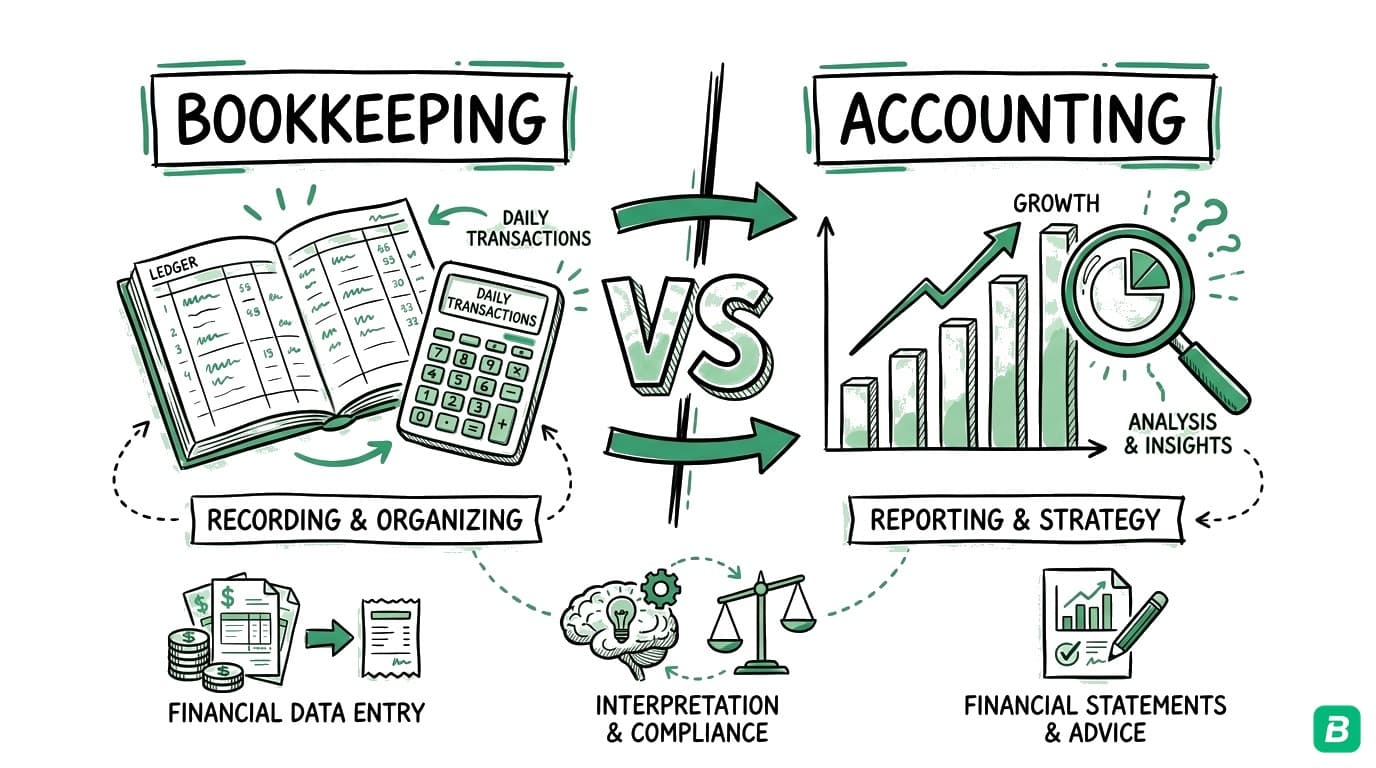
Bookkeeping vs Accounting: What You Actually Need
The real difference between bookkeeping and accounting — what each involves, what each costs, and which one your Canadian small business needs at each stage.
13 Bookkeeping Tips for Self-Employed Canadians
Practical, actionable tips for sole proprietors and freelancers — from separating personal and business bank accounts to tracking mileage, organizing receipts, and preparing for tax season.
Double-Entry Bookkeeping Explained for Canadians
Understanding debits and credits, the accounting equation, and why double-entry matters for Canadian small businesses. This foundational concept underpins every accounting system — even if you use software that handles it automatically.
Receipts, Expenses, and Reconciliation
How to Keep Track of Receipts for a Small Business
Five receipt tracking methods ranked from worst to best — plus how AI tools automate receipt scanning, categorization, and bank reconciliation.
How to Categorize Business Expenses (T2125 Categories)
Practical guide to categorizing expenses using CRA T2125 categories — with real examples for each category and tips for common grey-area expenses.
How to Reconcile Bank Statements
Step-by-step guide to bank statement reconciliation — matching transactions to receipts, finding discrepancies, and keeping books accurate every month.
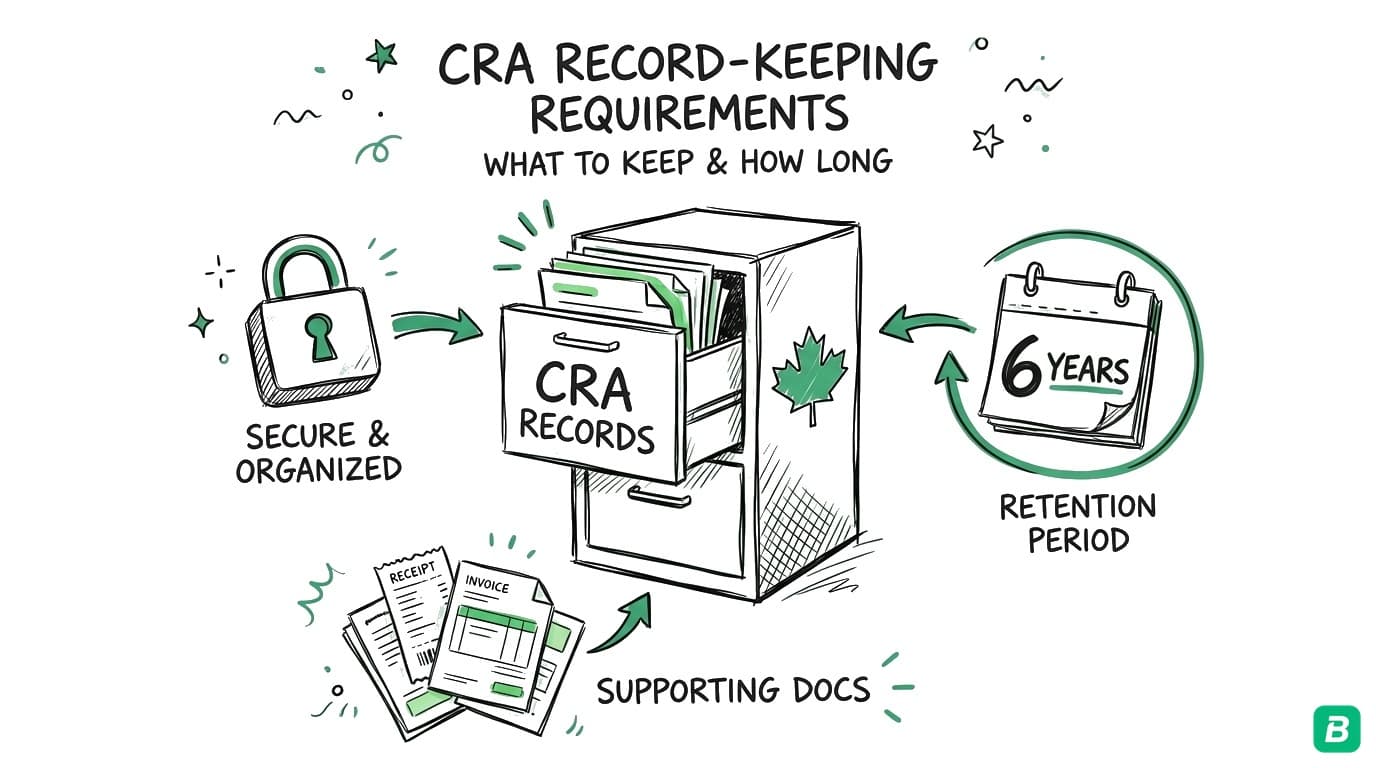
CRA Record-Keeping Requirements: What to Keep and How Long
Everything the CRA requires Canadian businesses to keep — which records, how long, digital vs paper rules, and penalties for non-compliance.
Catching Up and Cleaning Up
If your books are behind, these guides help you get back on track.
Bookkeeping Cleanup Guide for Canadian Businesses
Step-by-step process for cleaning up messy or neglected books — reconciling bank accounts, categorizing uncategorized transactions, finding missing receipts, and preparing records for tax filing. Includes timelines for how long cleanup takes based on how far behind you are.
Choosing Software
The right tool makes bookkeeping faster and catches deductions you would miss manually.
Bookkeeping Software Canada Comparison: Feature Grid
Side-by-side feature comparison of QuickBooks, FreshBooks, Wave, Xero, and BookZero across pricing, AI features, Canadian tax compliance, integrations, and scalability. Pure comparison tables — find the right tool for your business type.
Best Bookkeeping Software in Canada (2026)
Narrative reviews with recommendations by business type. Includes decision flowcharts and detailed pros/cons for each platform.
Free Bookkeeping Software in Canada
Options for businesses that need to minimize costs — Wave's free tier, BookZero's free credits, spreadsheet templates, and what you give up by choosing free.
AI and Automation
AI is changing how bookkeeping works. These guides explain what is practical today.
AI Bookkeeping for Small Business
What AI bookkeeping is, how it works, and what to look for in an AI bookkeeping tool. Covers receipt scanning, auto-categorization, tax detection, and transaction matching.
AI Receipt Scanning vs Traditional OCR
Technical comparison of AI scanning (using LLMs) versus traditional OCR. Covers accuracy rates, handling of difficult receipts, tax detection, and self-learning capabilities.
AI in Accounting: The Future
How artificial intelligence is transforming accounting and bookkeeping — current applications, limitations, and what is coming next. Relevant for business owners evaluating AI tools and accountants adapting their practice.
How BookZero's AI Bookkeeper Works
Behind-the-scenes look at the AI pipeline — receipt scanning, categorization, tax detection, and transaction matching. Includes accuracy rates and how the self-learning system improves over time.
Real Stories
How Bookkeeping Saved Me Thousands in Canada
Real examples of Canadian business owners who recovered significant tax savings by organizing their bookkeeping — missed deductions found, CRA audit preparation, and the cost of procrastination.
Frequently Asked Questions
How often should a small business do bookkeeping?
At minimum, once a week. Letting receipts and transactions pile up leads to errors, missed deductions, and tax-season panic. Weekly bookkeeping takes 15-30 minutes when your system is set up properly. Monthly works if you have very few transactions, but weekly is the standard recommendation from accountants.
Do I need an accountant if I use bookkeeping software?
Not necessarily for day-to-day bookkeeping — that is exactly what software handles. However, an accountant is valuable for tax planning, year-end review, and complex situations (incorporation decisions, multi-province operations, GST/HST edge cases). Many small businesses use software for the daily work and an accountant once a year at tax time.
What financial records does the CRA require me to keep?
The CRA requires you to keep records that support your income and expenses for at least six years. This includes invoices, receipts, bank statements, contracts, and any documents related to GST/HST collected or paid. Records can be digital — the CRA accepts electronic copies as long as they are legible and unaltered.
When should I start bookkeeping for a new business?
From day one. Every expense incurred while starting your business is potentially deductible — incorporation fees, website costs, equipment purchases, marketing spend. If you wait months to start tracking, you will lose receipts, forget expenses, and miss deductions. Set up your system before (or on the same day as) your first business transaction.
Where to Start
Brand new to bookkeeping? Read What Is Bookkeeping, then set up your system.
Need help with receipts? Start with How to Keep Track of Receipts, then learn how to categorize expenses.
Books are a mess? Go straight to the Cleanup Guide.
Want to automate? Read AI Bookkeeping for Small Business, then try BookZero free — 50 AI credits, no credit card required.

Eric Tech· Founder, BookZero.ai
Founder of BookZero. Building AI-powered bookkeeping tools for US and Canadian freelancers and small businesses.
View all postsStay ahead of tax season
Tax tips, deduction strategies, and feature announcements straight to your inbox. No spam, unsubscribe anytime.