How to Categorize Business Expenses in Canada: T2125 Categories Explained (2026)
A practical guide to categorizing business expenses using CRA T2125 categories — with real examples for each category and tips for common grey-area expenses.
 Eric Tech·Apr 20, 2026·15 min read·
If you run a business in Canada, you know the drill: every dollar you spend needs to go somewhere on your tax return. But figuring out where each expense belongs? That's where most people get stuck.
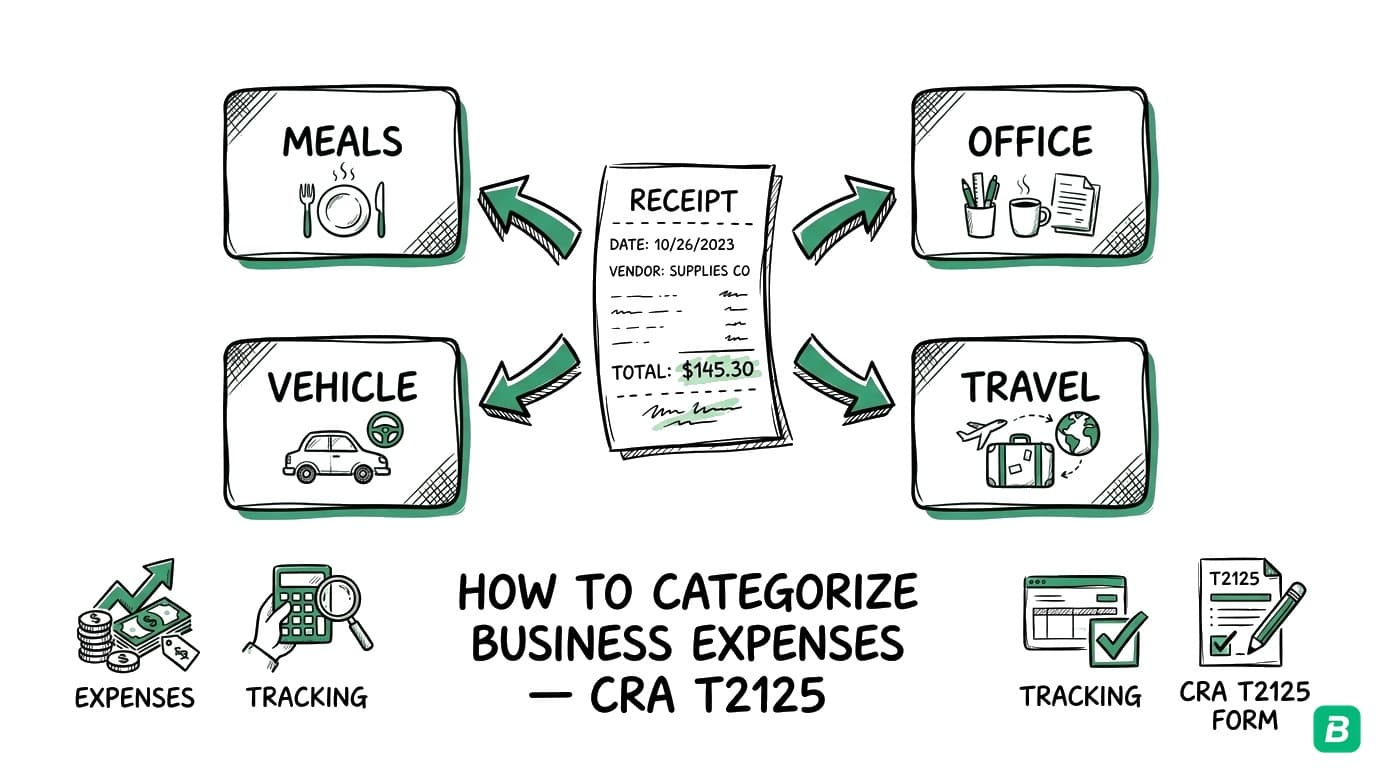
The Canada Revenue Agency (CRA) uses a specific set of categories on the T2125 form — the Statement of Business or Professional Activities. These categories determine how your expenses are reported and ultimately how much tax you pay.
This guide breaks down every T2125 category with real-world examples, covers the grey areas that trip people up, and gives you a system for categorizing business expenses correctly every time.
Pick a system, be consistent, and when in doubt, document the business purpose. Meals are only 50% deductible, fines never are, and anything over about $500 that lasts years is likely capital.
Why Correct Categorization Matters
Getting your expense categories right isn't just about being tidy. It directly affects:
- Your tax bill — some categories have special rules (like the 50% meals limitation)
- Audit risk — inconsistent or suspicious categorization flags your return
- Deduction eligibility — putting an expense in the wrong category could mean losing the deduction entirely
- Year-over-year tracking — consistent categorization helps you spot trends in your spending
The CRA cross-references your expense ratios against industry averages. If your "meals and entertainment" is 40% of revenue while the average for your industry is 5%, expect questions.
The Complete T2125 Expense Categories
Here's every category on the T2125 form, what belongs in each, and what doesn't. If you're new to bookkeeping in Canada, bookmark this section.
1. Advertising
This covers any expense related to promoting your business to potential customers.

Examples:
- Google Ads and Facebook Ads spend
- Business cards and brochures
- Website hosting and domain registration
- Sponsored posts on social media
Does NOT include: website development costs over $500 (that's likely capital, not an expense), or gifts to clients (that's a separate consideration).
2. Meals and Entertainment
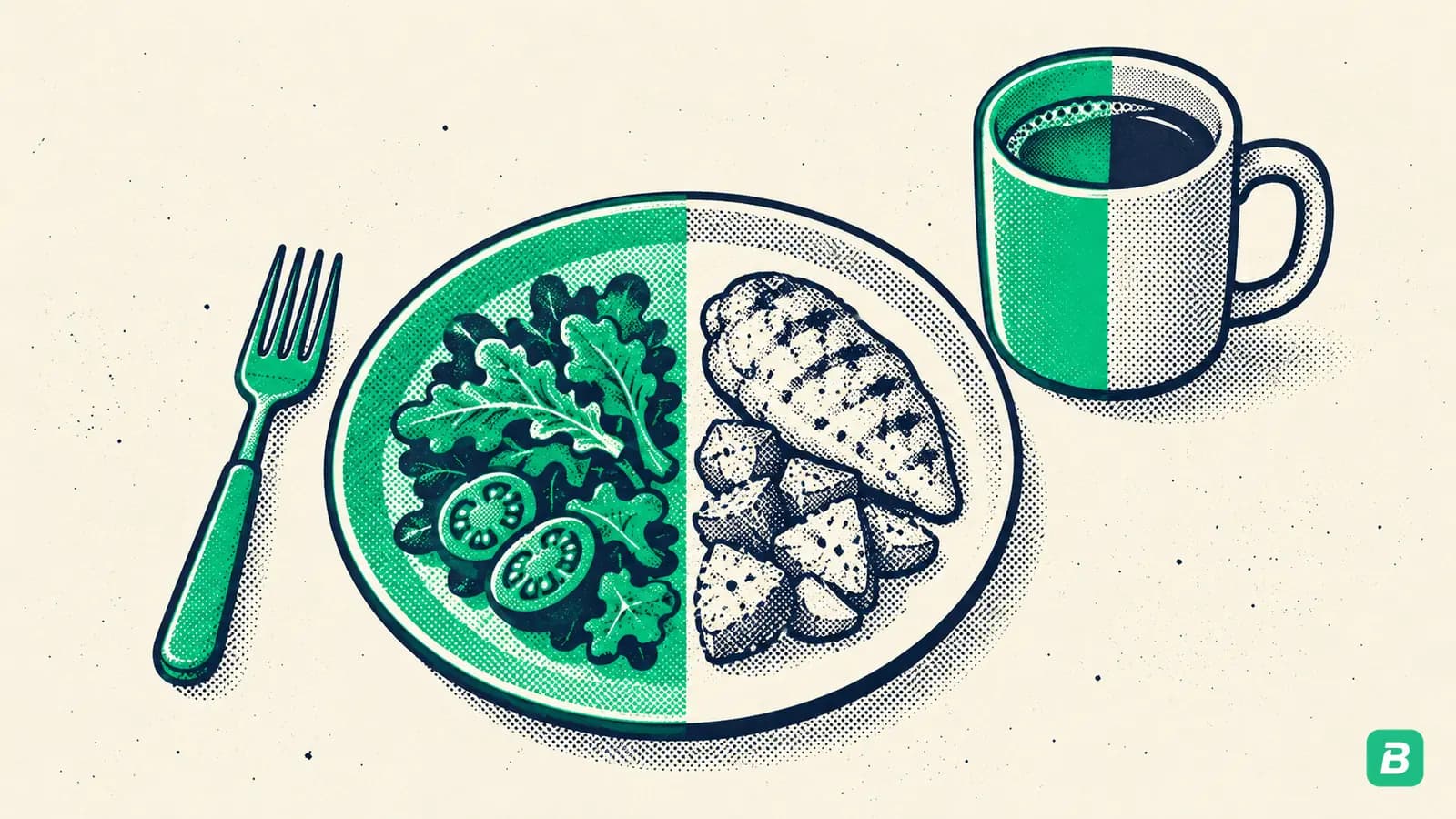
Business meals with clients, suppliers, or employees. The key rule: only 50% of meals and entertainment expenses are deductible.
Examples:
- Lunch with a client to discuss a project
- Team dinner after a product launch
- Taking a potential partner for coffee to discuss collaboration
- Event tickets for a client meeting
Does NOT include: your personal lunch while working (even if you're at your desk), groceries, or meals that have no business connection.
You track the full amount but only deduct 50% on your tax return. If you spent $2,000 on client meals, you deduct $1,000. Some exceptions exist for long-haul truckers and certain events — check with your accountant.
3. Motor Vehicle Expenses
If you use a vehicle for business, you can deduct the business-use portion of your vehicle costs.
Examples:
- Gas and fuel
- Insurance premiums
- Oil changes and maintenance
- Parking fees for business meetings
The business-use percentage calculation:
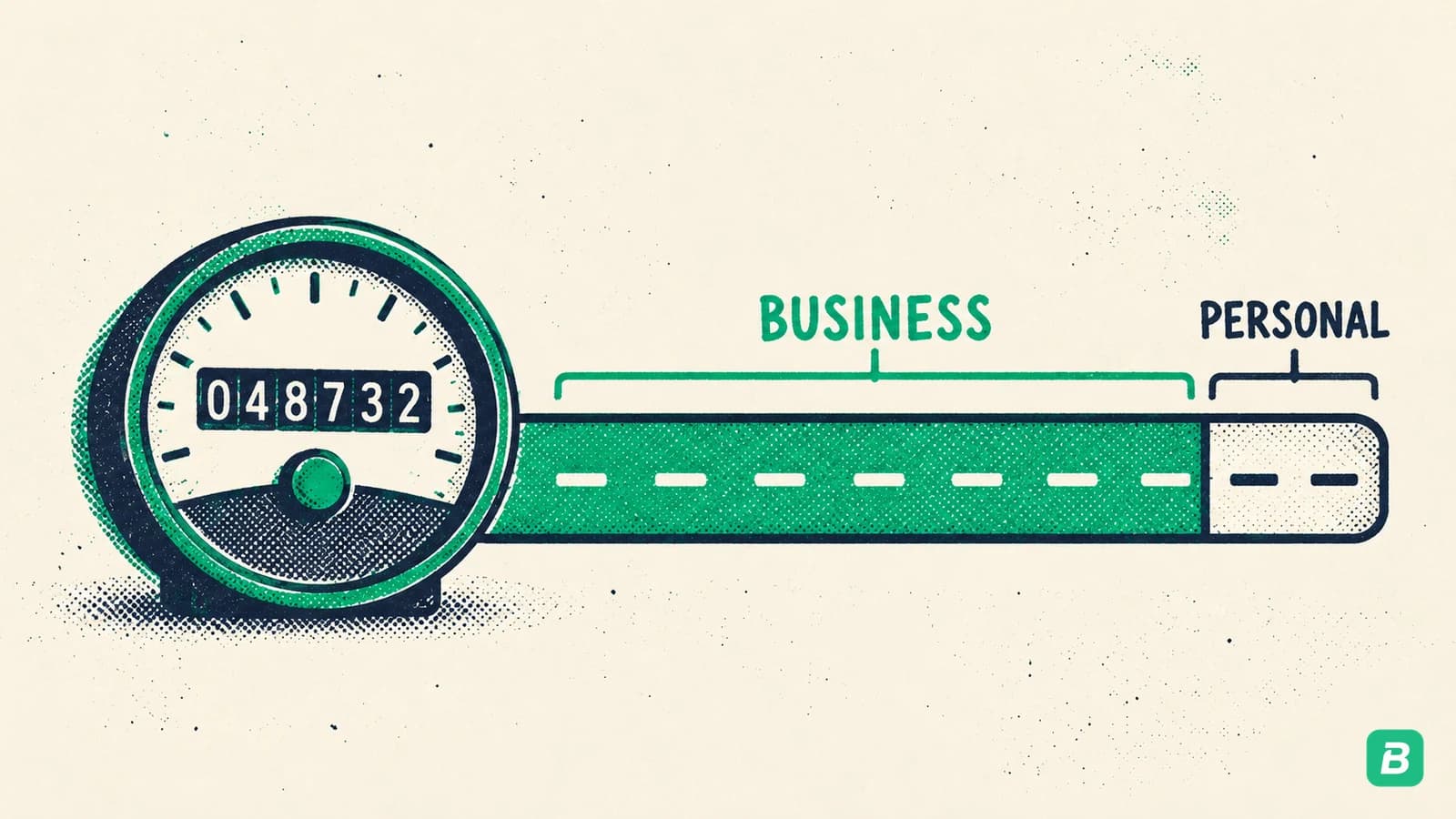
You need to track your total kilometres driven in the year and how many were for business. If you drove 20,000 km total and 12,000 km were business, your business-use percentage is 60%. You can deduct 60% of all vehicle expenses.
For more vehicle expense examples, see our guide on Uber driver tax deductions.
Does NOT include: traffic tickets, commuting from home to your regular office, or personal errands.
4. Office Expenses
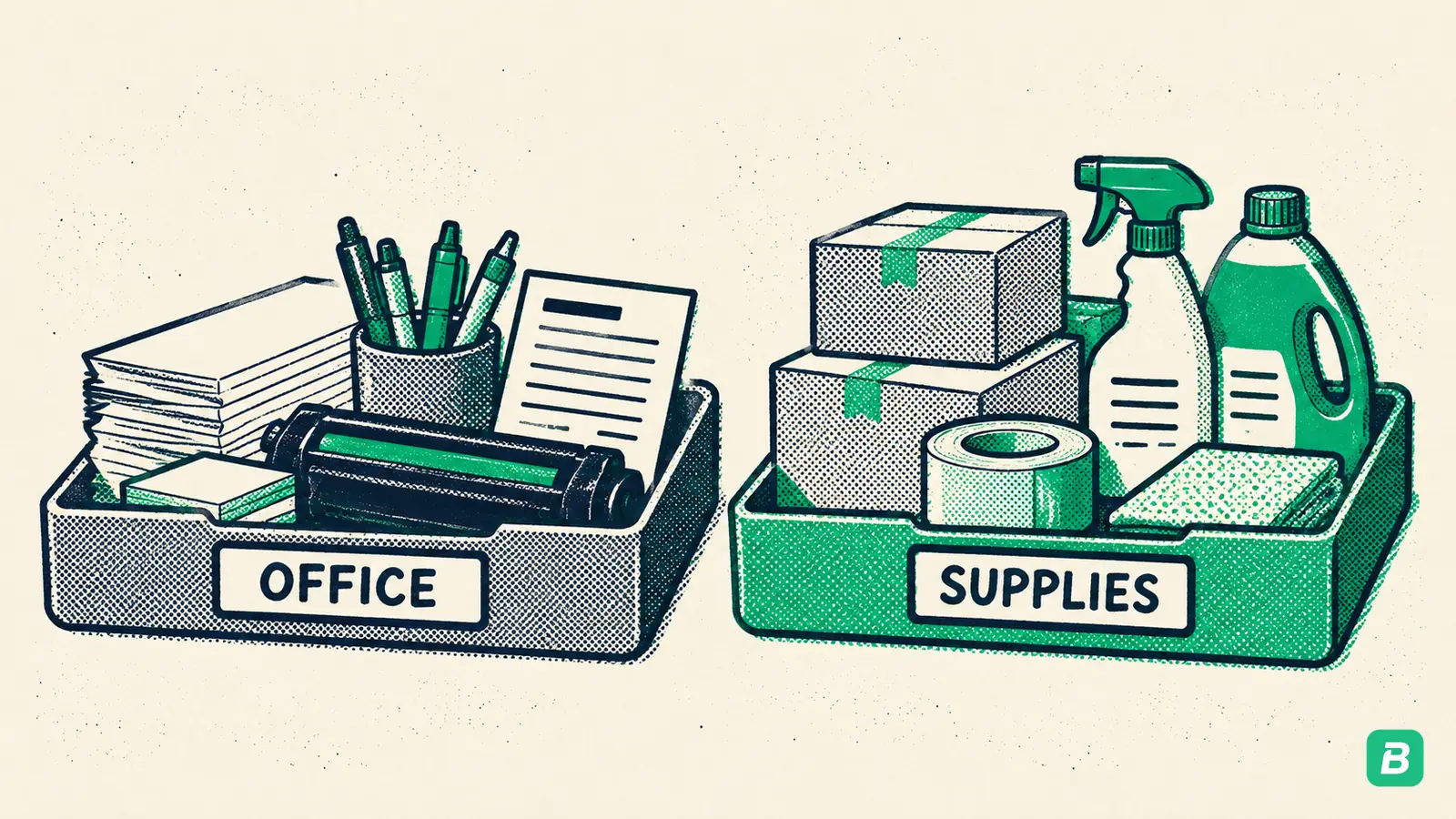
Small, consumable items you use in your office. Think supplies that get used up relatively quickly.
Examples:
- Pens, paper, and notebooks
- Printer toner and ink cartridges
- USB drives and cables
- Postage and shipping supplies
Does NOT include: furniture (that's capital), computers over $500 (likely CCA), or software subscriptions (often "other expenses").
5. Supplies
Materials that are directly consumed in delivering your business services or products. This is different from office expenses — supplies relate to your actual business output.
Examples:
- Cleaning supplies for a cleaning business
- Packaging materials for an e-commerce store
- Raw materials for a craft business
- Photography prints for a photography studio
Does NOT include: inventory you're reselling (that's cost of goods sold), or general office supplies (that's the category above).
6. Professional Fees (Including Legal and Accounting)
Fees paid to licensed professionals for business services.
Examples:
- Accountant fees for tax preparation
- Lawyer fees for contract review
- Bookkeeper fees for monthly reconciliation
- Consultant fees for business strategy
Does NOT include: fees for personal tax preparation (only the business portion), or professional development courses (that's education, often under "other expenses").
7. Rent
Costs for renting space used for your business operations.
Examples:
- Office rent
- Co-working space membership
- Storage unit for business inventory
- Retail space lease
Does NOT include: your home office (that's "business-use-of-home"), or equipment rentals (often under "other expenses" or specific equipment categories).
8. Telephone and Utilities
Communication costs and utilities for your business space.
Examples:
- Business phone line
- Internet service (business-use portion)
- Cell phone plan (business-use portion)
- VoIP service like Zoom or Google Voice
Business-use percentage: If you use your cell phone 70% for business, deduct 70% of your monthly bill. Keep a log for the first few months to establish your ratio.
Does NOT include: utilities for your home office (that falls under "business-use-of-home").
9. Travel
Expenses incurred when travelling away from your home city for business purposes.
Examples:
- Flights to meet clients or attend conferences (here's how to get an American Airlines receipt after the trip)
- Hotel stays during business trips
- Meals while travelling (subject to 50% rule)
- Ground transportation (taxis, Uber, rental cars). Here's how to get an Uber receipt for each ride
Does NOT include: daily commuting, travel that's primarily personal with some business sprinkled in, or spouse's travel expenses (unless they have a legitimate business role).
10. Insurance
Premiums for insurance that protects your business.
Examples:
- General liability insurance
- Professional indemnity (errors & omissions)
- Commercial property insurance
- Business interruption insurance
Does NOT include: personal life insurance, health insurance premiums (these may be deductible elsewhere), or vehicle insurance (that goes under motor vehicle expenses).
11. Business-Use-of-Home Expenses
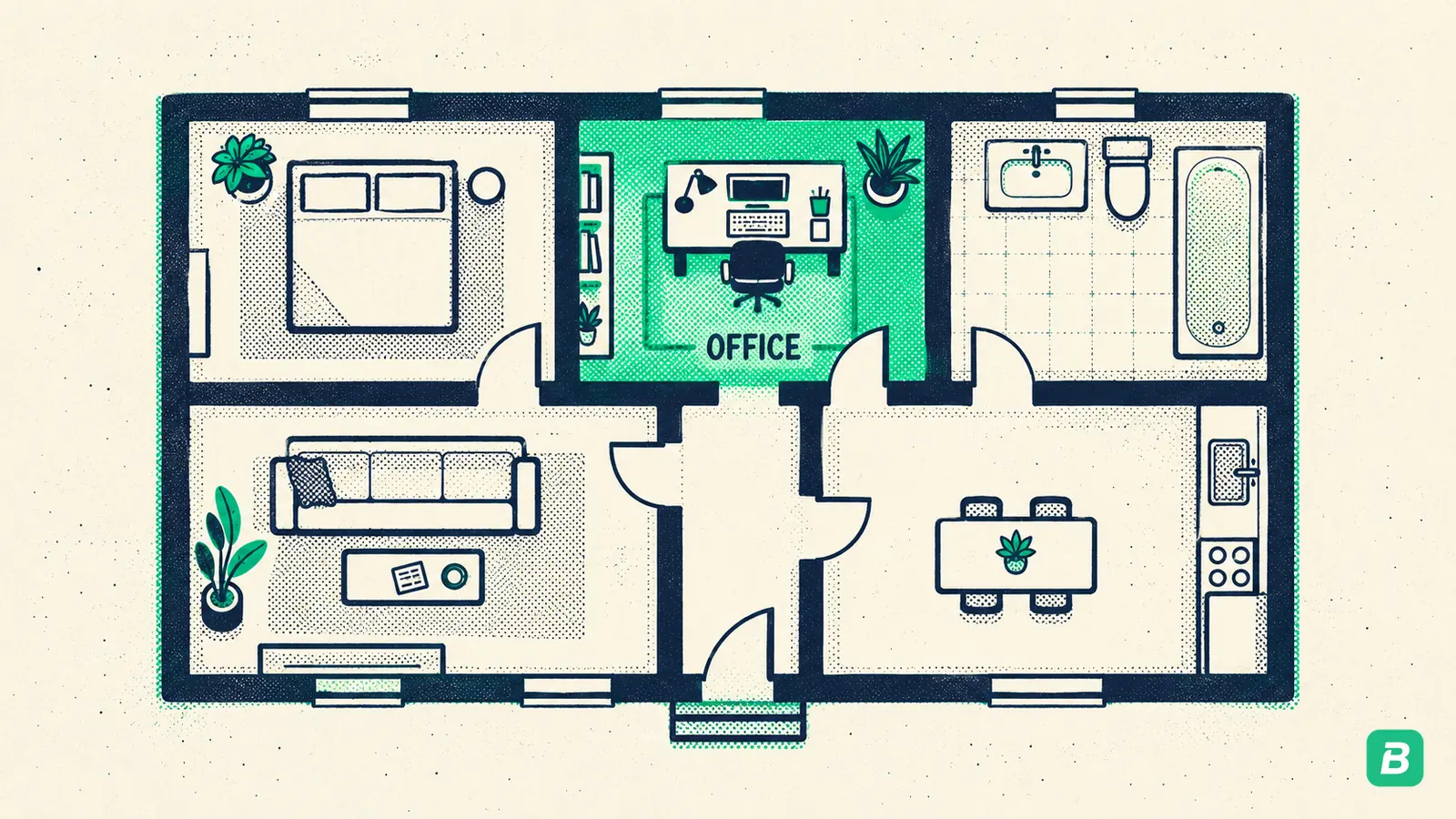
If you work from home, you can deduct a portion of your home costs based on the percentage of your home used for business.
Examples:
- Portion of rent or mortgage interest
- Portion of property taxes
- Portion of home insurance
- Portion of utilities (heat, electricity, water)
The calculation: Measure your dedicated workspace. If your office is 150 sq ft and your home is 1,500 sq ft, your business-use percentage is 10%. Deduct 10% of eligible home expenses.
Your home office must be either your principal place of business OR used exclusively and regularly for meeting clients. A kitchen table where you sometimes answer emails doesn't qualify.
12. Other Expenses
A catch-all for legitimate business expenses that don't fit neatly into the categories above.
Examples:
- Software subscriptions (QuickBooks, Slack, Canva)
- Bank fees and merchant processing fees
- Professional development courses
- Licences and permits
Does NOT include: personal expenses you're trying to squeeze in, or anything that should clearly go in one of the named categories above.
Quick Reference Table
| Category | Real-World Examples | Special Rules |
|---|---|---|
| Advertising | Google Ads, business cards, website hosting, social media ads | Must target potential customers |
| Meals and entertainment | Client lunches, team dinners, networking coffee | Only 50% deductible |
| Motor vehicle expenses | Gas, insurance, oil changes, parking | Business-use % only |
| Office expenses | Pens, toner, USB drives, postage | Consumable items only |
| Supplies | Packaging, cleaning products, raw materials | Must relate to business output |
| Professional fees | Accountant, lawyer, bookkeeper, consultant | Business portion only |
| Rent | Office space, co-working, storage unit | Not home office |
| Telephone and utilities | Phone, internet, VoIP | Business-use % for shared lines |
| Travel | Flights, hotels, trip meals, rental cars | Must be away from home city |
| Insurance | Liability, E&O, commercial property | Business policies only |
| Business-use-of-home | Rent/mortgage interest, property tax, utilities | Square footage % method |
| Other expenses | Software, bank fees, courses, licences | Legitimate business purpose required |
The Grey Area: Common Confusing Expenses
These are the expenses that trip up almost every small business owner. Here's how to handle them:
Laptop or Computer — Office Expense or Capital Cost?
The rule: If it costs under $500, you can expense it as an office expense. Over $500, it's generally a capital expenditure and goes into CCA (Capital Cost Allowance) Class 50, which means you depreciate it over time at 55% per year.
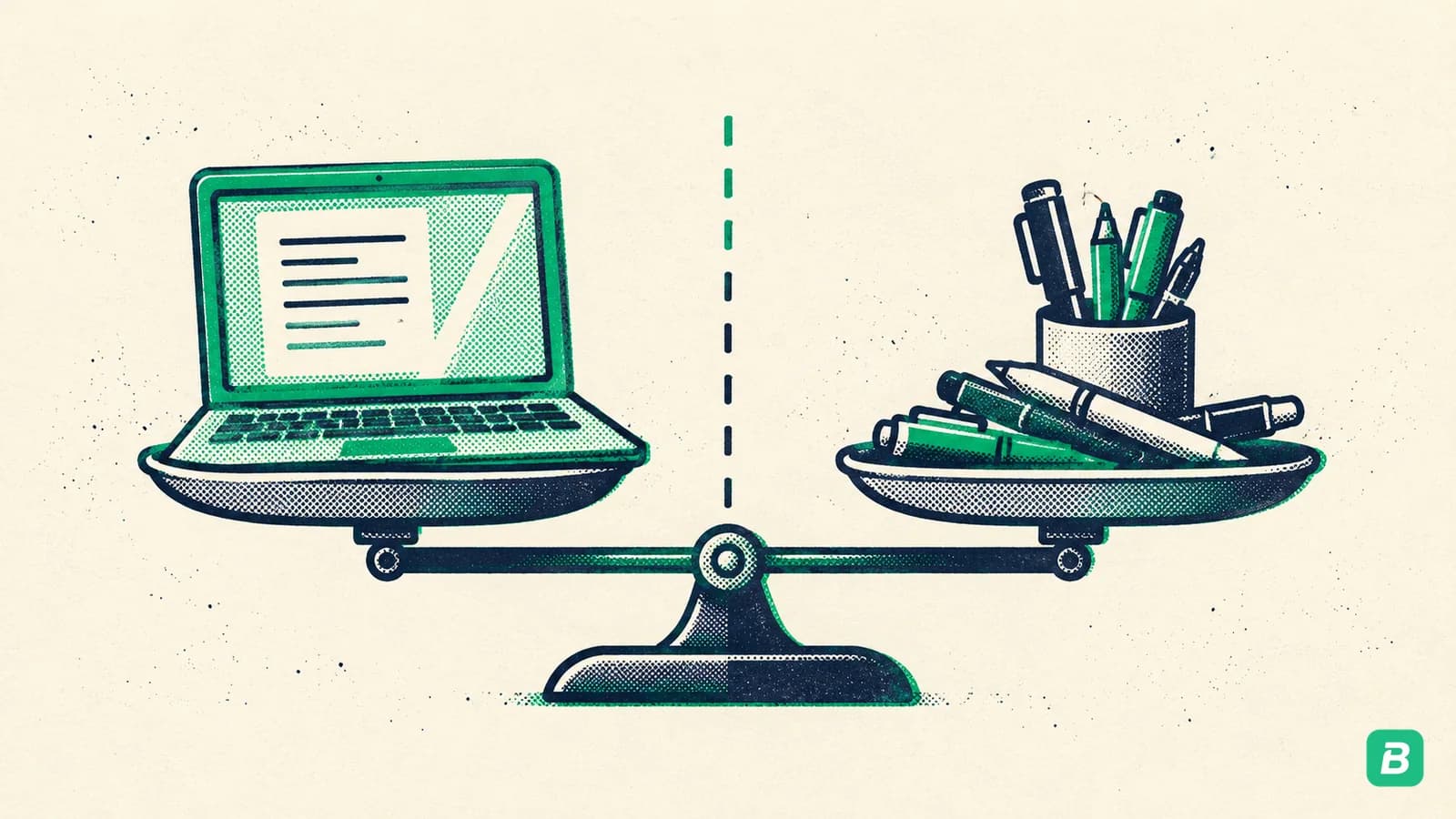
Practical tip: A $450 keyboard and mouse? Office expense. A $2,000 MacBook Pro? CCA. Some accountants will still expense items up to $1,000 as "other expenses" — ask yours about their threshold.
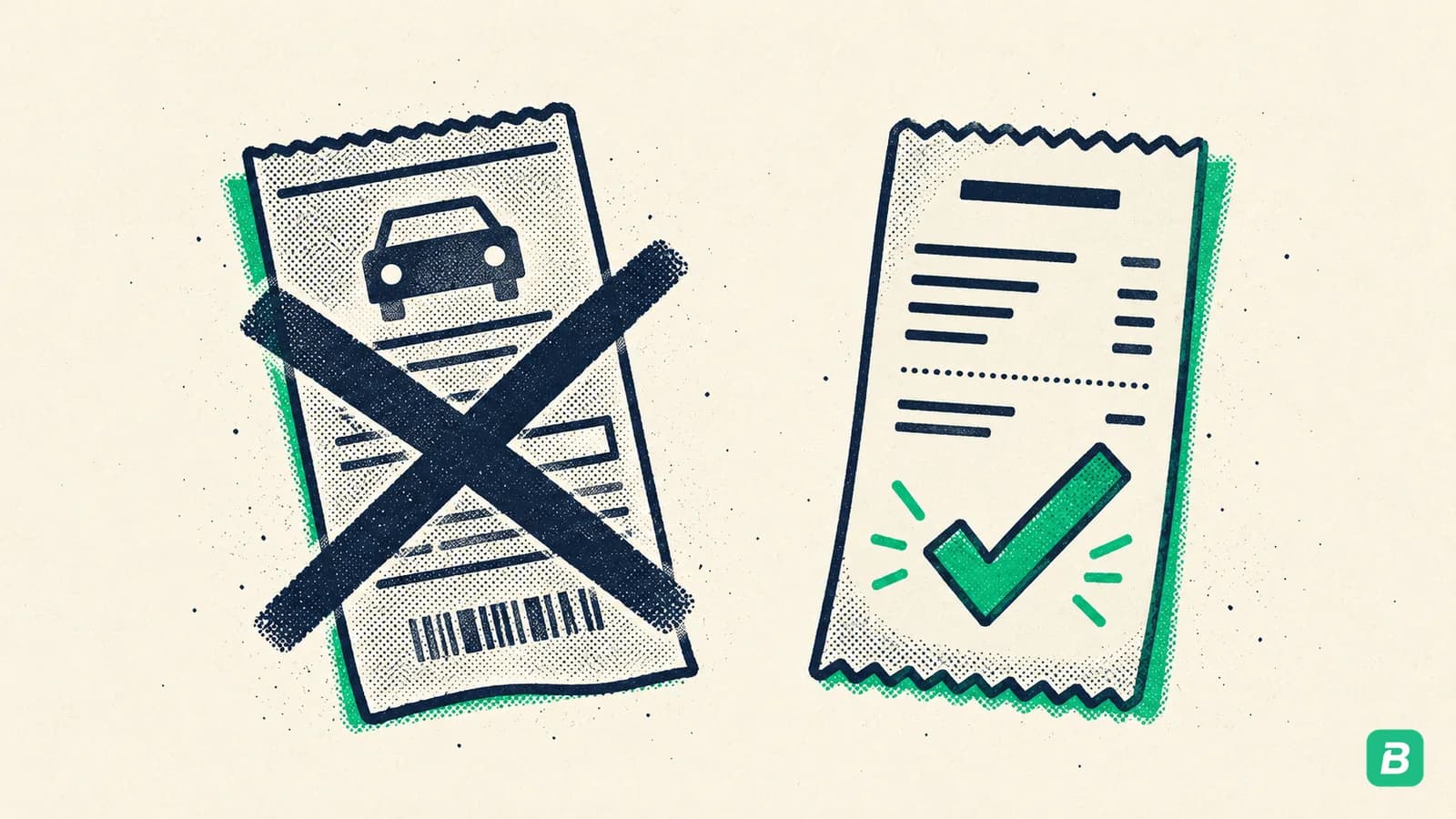
Parking Tickets — NOT Deductible
Fines and penalties are never deductible. This includes parking tickets, speeding tickets, and late-filing penalties. The CRA is clear: you don't get a tax break for breaking rules.
Gym Membership — Generally NOT Deductible
Unless your business is directly fitness-related (personal trainer, fitness influencer), a gym membership is a personal expense. Even if you argue it keeps you productive, the CRA doesn't buy it.
Exception: If you're a personal trainer and use a gym as your workplace, the membership could qualify as rent or a business expense.
Coffee with a Client — Meals and Entertainment (50%)
If you meet a client at a coffee shop and discuss business, the coffees are a meals and entertainment expense. You'll deduct 50% of the cost. Keep the receipt and note who you met and what you discussed.
Coffee for Yourself While Working — NOT Deductible
Your daily latte while you work at a cafe? That's personal. There's no client, no business meeting, no business purpose beyond "I like coffee." Same goes for snacks you buy while working.
Cell Phone — Telephone (Business-Use % Only)
If you use one phone for everything, you can only deduct the business-use percentage. If 60% of your calls and data usage is business-related, deduct 60% of your monthly bill. The CRA may ask how you arrived at your percentage, so keep notes.
For any expense that's borderline, write a quick note on the receipt: who was there, what was discussed, and why it's a business expense. This takes 10 seconds and can save you thousands in a disputed audit.
How to Build a Categorization System That Works
Knowing the categories is one thing. Actually categorizing expenses consistently every week is another. Here's a practical system:
Step 1: Capture Every Receipt
You can't categorize what you don't have. Use a system to track your receipts — whether that's a phone app, a folder in your email, or an envelope in your bag.
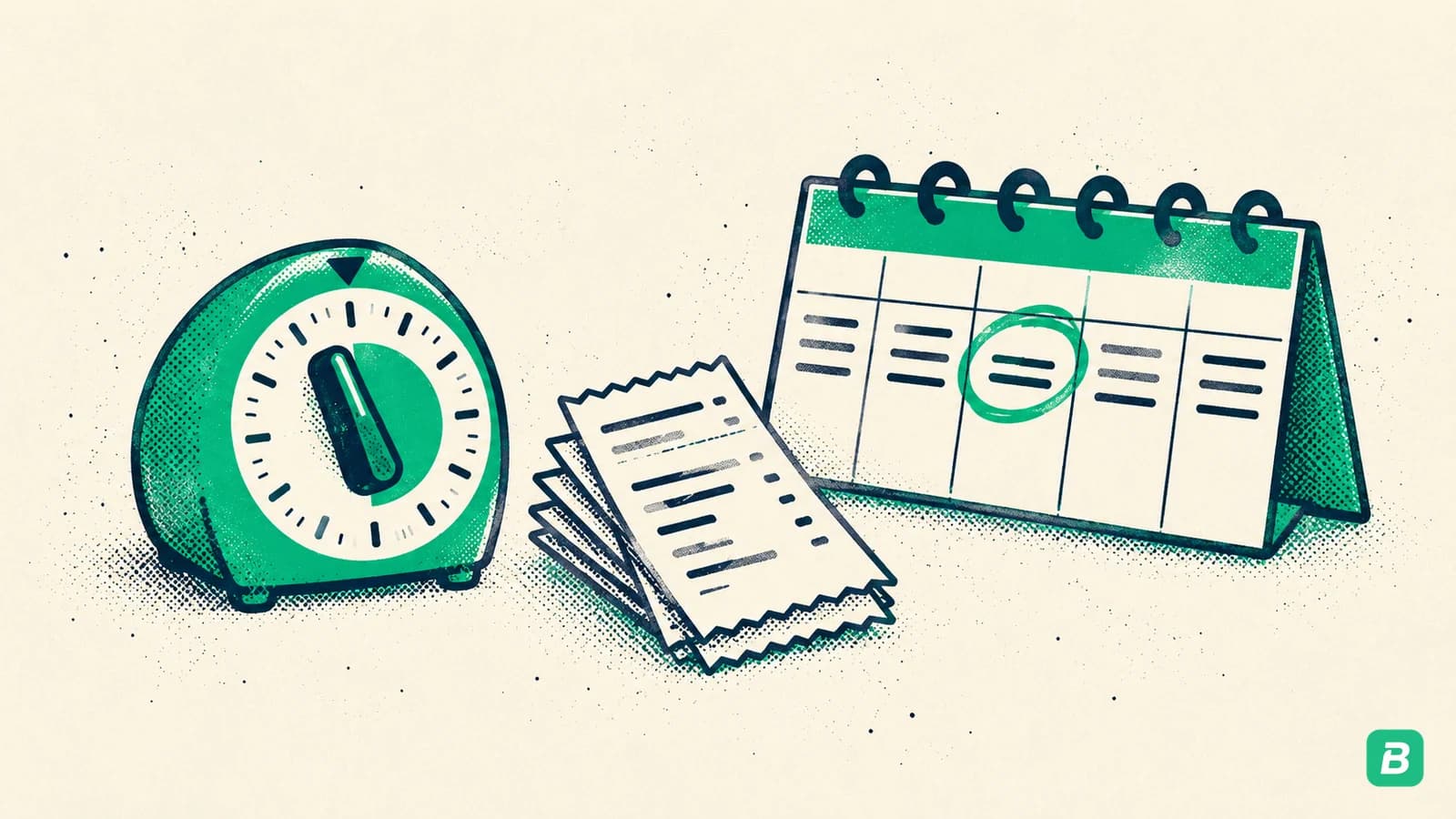
Step 2: Categorize Weekly (Not Yearly)
The biggest mistake freelancers make is dumping a year's worth of receipts on their accountant in March. By then, you've forgotten whether that coffee was with a client or by yourself.
Set aside 15 minutes each week to categorize the past week's expenses. Your memory is fresh and it never becomes overwhelming.
Step 3: Use the "Business Purpose" Test
For every expense, ask: Would I have spent this money if I didn't have a business? If the answer is no, it's likely deductible. If the answer is "maybe" — you're in grey territory and should apply the percentage rules.
Step 4: Automate Where Possible
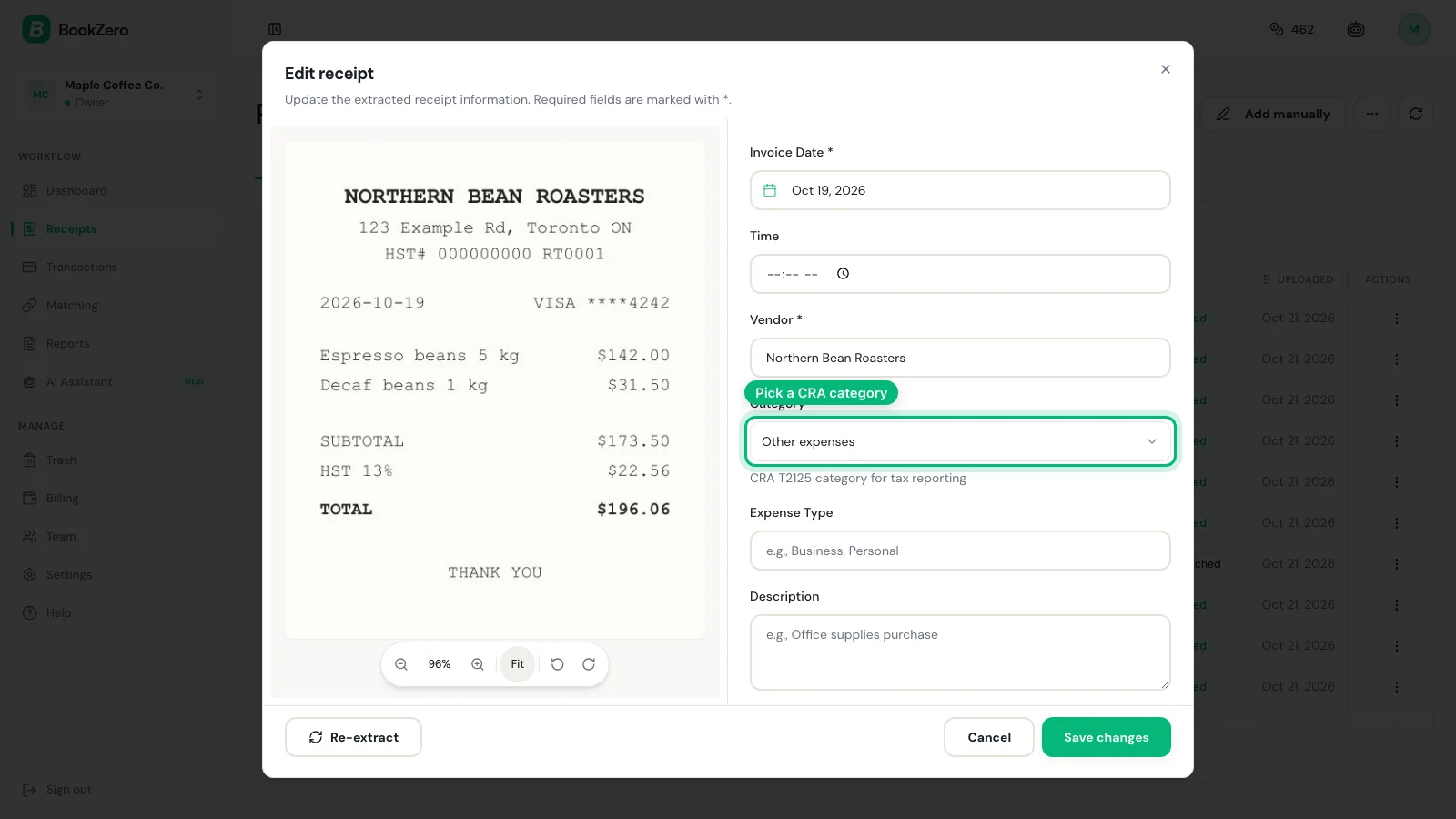
Modern bookkeeping tools can suggest a category for each expense from what's on the receipt. AI-powered bookkeeping does the first pass, and you review and correct the suggestions.
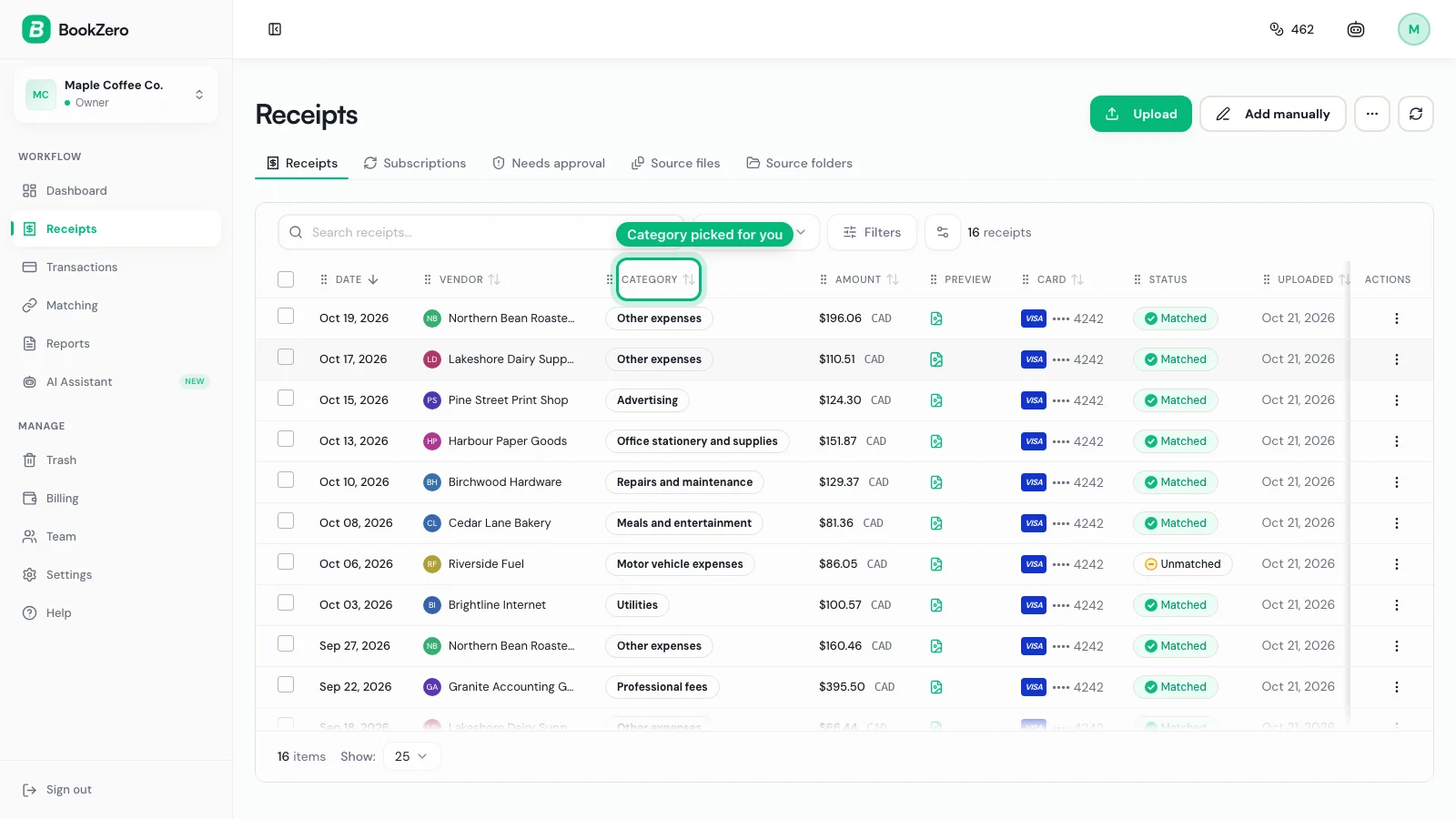
The CRA cares more about consistency than perfection. If you always put Zoom under "telephone and utilities" and your colleague puts it under "other expenses" — both are defensible. What matters is that you do the same thing every time.
Common Mistakes to Avoid
-
Mixing personal and business expenses — Keep separate bank accounts and credit cards. It makes categorization drastically easier.
-
Over-claiming vehicle expenses — If you claim 90% business use, the CRA will want to see a detailed log. Be honest about your ratio.
-
Forgetting the 50% meals rule — Track the full amount but remember only half is deductible when you file.
-
Missing the home office deduction — Many self-employed people forget this entirely. If you work from home regularly, calculate your percentage and claim it.
-
Expensing capital items — That $3,000 camera doesn't go under "office expenses." It's CCA. Expensing capital items can trigger an audit.
For a complete list of what you can deduct, see our small business tax deductions guide.
FAQ
How many expense categories are on the T2125 form?
The T2125 form has approximately 20 line items for expenses, but the main categories most small businesses use are the 12 covered in this guide. Some additional lines exist for specific situations like "management and administration fees" and "delivery, freight, and express." You can find the full form on the CRA website.
What happens if I put an expense in the wrong category?
In most cases, nothing catastrophic — the total deduction amount is the same regardless of which line it appears on. However, misplacing expenses can raise red flags if one category looks unusually large, or if you claim 100% of something that should be percentage-based (like meals at 50%). If you realize a mistake after filing, you can request an adjustment through CRA My Account.
Do I need receipts for every single expense?
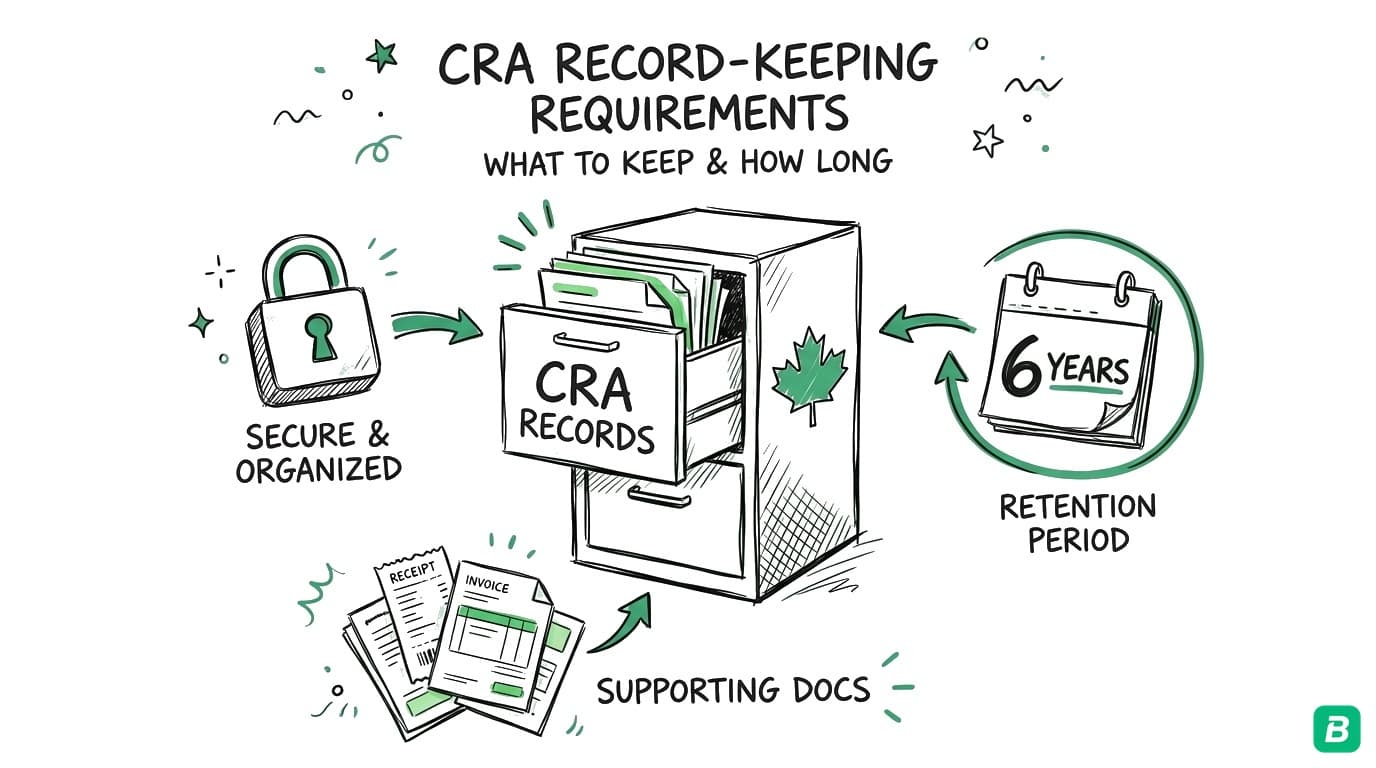
The CRA requires you to keep records that support your claims for at least six years. For expenses under $75, a bank or credit card statement may suffice in practice, but having the actual receipt is always safer — especially for meals and entertainment where you need to document the business purpose. Learn more about receipt requirements for small businesses.
Can I claim expenses from before I officially registered my business?
Yes — you can claim reasonable start-up costs incurred before your business began operating. These might include market research, professional fees for incorporation, initial supplies, or training. Keep all receipts from your pre-launch period and discuss timing with your accountant.
What's the difference between an expense and a capital expenditure?
An expense is something consumed or used up within the year (printer paper, a software subscription, an ad campaign). A capital expenditure is an asset with lasting value that you use over multiple years (a computer, a vehicle, office furniture). Capital expenditures are depreciated over time through CCA rather than deducted in full the year you buy them. The threshold is generally $500, though some accountants use higher thresholds for practical purposes.
Next Steps
Filing US self-employment income? Use our Schedule C business expense categories guide for a US record-organization workflow and filing-year review points. CRA T2125 categories and IRS Schedule C categories have different structures.
Getting your expense categorization right is one of the most impactful things you can do for your tax situation. It's not complicated once you understand the system — it just requires consistency.
If you want to learn more about the T2125 form itself, check out our complete T2125 form guide. For understanding how GST/HST interacts with your expenses, see our GST/HST guide. And for a broader understanding of what bookkeeping actually involves, start there.
The key takeaway: pick a system, be consistent, and when in doubt, document the business purpose. Your future self (and your accountant) will thank you.
BookZero automatically categorizes your expenses using CRA T2125 categories — try it free.



Eric Tech· Founder, BookZero.ai
Founder of BookZero. Building AI-powered bookkeeping tools for US and Canadian freelancers and small businesses.
View all postsStay ahead of tax season
Tax tips, deduction strategies, and feature announcements straight to your inbox. No spam, unsubscribe anytime.