Canadian Tax Guide for Self-Employed Workers and Small Businesses (2026)
Complete guide to Canadian taxes for freelancers, gig workers, and small businesses — deadlines, deductions, GST/HST, T2125, and year-end planning.
 Eric Tech·Mar 18, 2026·5 min read·
This guide is for informational purposes only and does not constitute tax advice. Consult a qualified tax professional for your specific situation.
Your Complete Canadian Tax Resource
If you are self-employed, freelancing, or running a small business in Canada, your tax obligations are more complex than a salaried employee's. You handle your own income tax, CPP contributions, GST/HST, quarterly instalments, and CRA reporting — with no employer doing it for you.
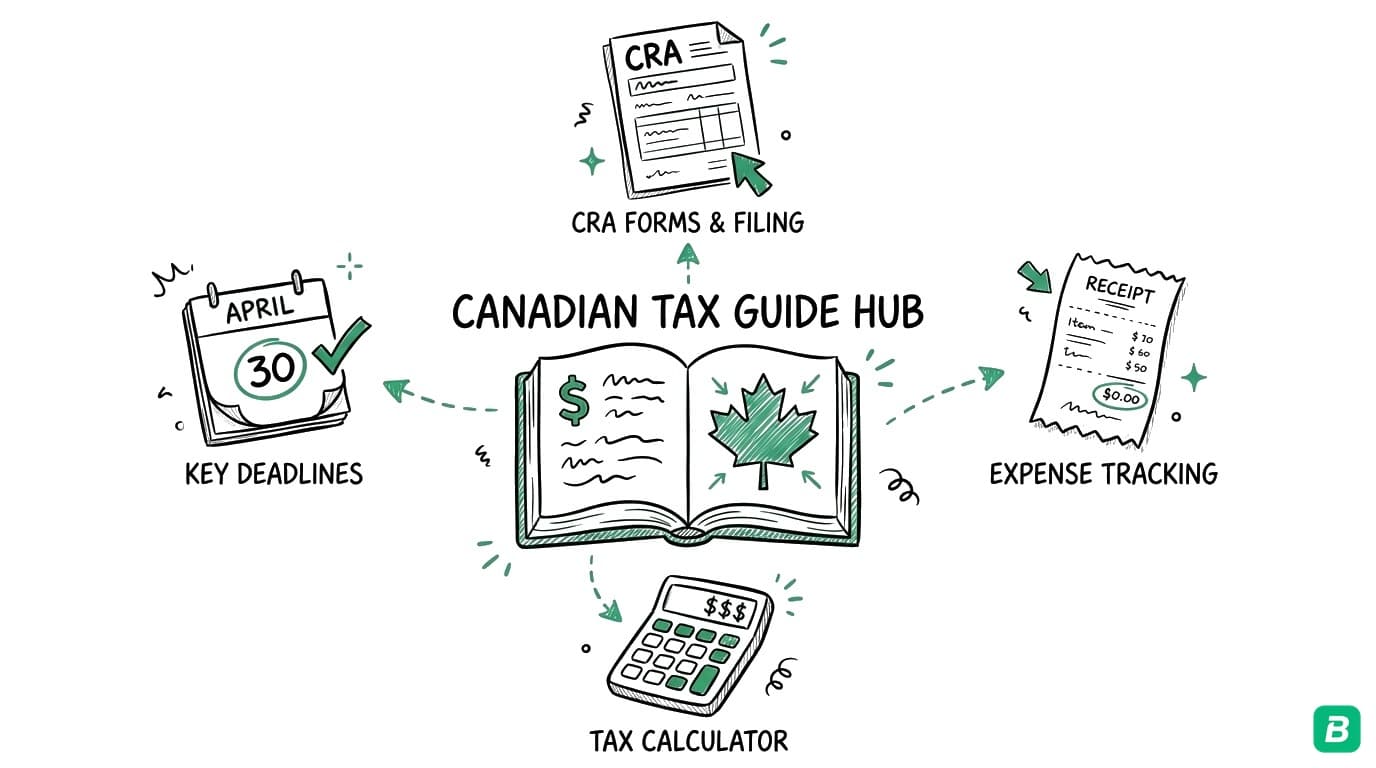
This hub page connects every tax guide we have written into one organized resource. Start with whichever topic is most relevant to your situation, or work through them in order for a complete understanding of Canadian self-employment taxes.
Tax Deadlines and Filing
Understanding when things are due is the first step. Missing a deadline costs real money in penalties and interest.
Canada Tax Deadlines 2026: Every CRA Due Date You Need to Know
Every federal and provincial deadline for 2026 — personal filing (April 30), self-employed filing (June 15), quarterly instalments, GST/HST remittances, corporate filing, and employer obligations. Includes a month-by-month calendar and penalty calculations.
How to File Taxes as a Self-Employed Canadian
Step-by-step walkthrough of the self-employed filing process — from gathering T4 and T5 slips through completing your T2125, calculating CPP, and submitting your T1 return. Covers the April 30 payment vs June 15 filing distinction that trips up many freelancers.
Tax Forms and Compliance
The CRA requires specific forms and documentation. These guides walk through the most important ones.
T2125 Form Guide for Self-Employed Canadians
Line-by-line guide to completing the Statement of Business or Professional Activities. Covers business identification, revenue reporting, expense categories (Parts 7-10), Capital Cost Allowance, vehicle expenses, and home office calculations. The T2125 is the core tax form for every sole proprietor.
GST/HST Guide for Small Businesses in Canada
When to register, how to collect, filing frequencies, Input Tax Credits, the Quick Method, and common mistakes. Covers the $30,000 threshold, provincial variations (HST, GST+PST, QST), and how to file your GST/HST return.
Deductions and Tax Savings
Claiming every legitimate deduction is the most direct way to reduce your tax bill. These guides cover what you can claim and how to document it.
Small Business Tax Deductions in Canada
Comprehensive list of deductions available to Canadian small businesses and self-employed workers — home office, vehicle, meals and entertainment, professional development, supplies, insurance, and more. Includes CRA rules for each deduction and documentation requirements.
Year-End Tax Checklist for Self-Employed Canadians
Month-by-month checklist from October through March covering pre-year-end preparation, year-end closing, document gathering, and filing. Includes specific tasks for each phase so you are not scrambling in April.
Industry-Specific Guides
Different industries have different deduction patterns and tax considerations.
Uber Driver Tax Deductions in Canada
Complete guide to tax deductions for rideshare drivers — vehicle expenses (mileage, fuel, maintenance, insurance), phone and data, GST/HST obligations, and how to track business vs personal use. Includes the CRA vehicle log requirement.
DoorDash and Uber Eats Tax Deductions in Canada
Tax deductions specific to food delivery drivers — vehicle costs, insulated bags, parking, phone mounts, and platform-specific reporting. Covers how delivery income differs from rideshare for tax purposes.
Bookkeeping for Gig Workers in Canada
How gig workers should organize their finances — separating personal and business expenses, tracking multiple income sources, GST/HST threshold monitoring, and preparing for tax time when you have income from multiple platforms.
Tools and Resources
Choosing the right bookkeeping tool can save hours per month and catch deductions you would otherwise miss.
Best Bookkeeping Software in Canada (2026)
In-depth reviews of QuickBooks, FreshBooks, Wave, Xero, and BookZero with recommendations by business type. Narrative-style reviews with pros, cons, and decision criteria.
Bookkeeping Software Canada Comparison: Feature Grid
Side-by-side feature comparison across pricing, AI features, tax compliance, integrations, and scalability. Pure comparison format — no narrative, just facts and tables.
Frequently Asked Questions
When are self-employed taxes due in Canada?
Self-employed Canadians have until June 15 to file their tax return, but any taxes owed are still due by April 30. If you owe money and file after April 30, interest starts accumulating immediately — even though the filing deadline is later. See our 2026 tax deadlines guide for all key dates.
Do self-employed Canadians need to pay CPP?
Yes. Self-employed individuals pay both the employee and employer portions of CPP contributions. As of 2026, the combined rate is 11.9% on net self-employment income between $3,500 and the annual maximum pensionable earnings. This is one of the largest costs of being self-employed in Canada.
What is the penalty for filing taxes late in Canada?
The initial late-filing penalty is 5% of the balance owing, plus 1% for each full month the return is late, up to a maximum of 12 months. If you have been assessed a late-filing penalty in any of the three previous years, the penalty doubles to 10% plus 2% per month for up to 20 months.
Can I deduct expenses from before I registered my business?
Yes, within limits. The CRA allows you to deduct reasonable startup costs incurred before your business began operating, as long as they were directly related to the business. Common examples include market research, legal fees for incorporation, and website development costs.
Where to Start
New to self-employment? Start with How to File Taxes as a Self-Employed Canadian, then read the T2125 Form Guide.
Tax season approaching? Check the 2026 Tax Deadlines and follow the Year-End Tax Checklist.
Looking to save money? Read Small Business Tax Deductions and the GST/HST Guide to ensure you are claiming everything you are entitled to.
Ready to automate your bookkeeping? Try BookZero free — 50 AI scanning credits, no credit card required.

Eric Tech· Founder, BookZero.ai
Founder of BookZero. Building AI-powered bookkeeping tools for US and Canadian freelancers and small businesses.
View all postsStay ahead of tax season
Tax tips, deduction strategies, and feature announcements straight to your inbox. No spam, unsubscribe anytime.