Canada Tax Deadlines 2026: Every CRA Due Date You Need to Know
Complete guide to every Canadian tax deadline in 2026 — personal filing, self-employed, corporate, GST/HST, RRSP, quarterly instalments, and penalties for late filing.
 Eric Tech·Mar 18, 2026·21 min read·
This guide is for informational purposes only and does not constitute tax advice. Consult a qualified tax professional for your specific situation. All deadlines are based on 2026 CRA guidelines. When a deadline falls on a weekend or holiday, the CRA extends it to the next business day.
Key Takeaways
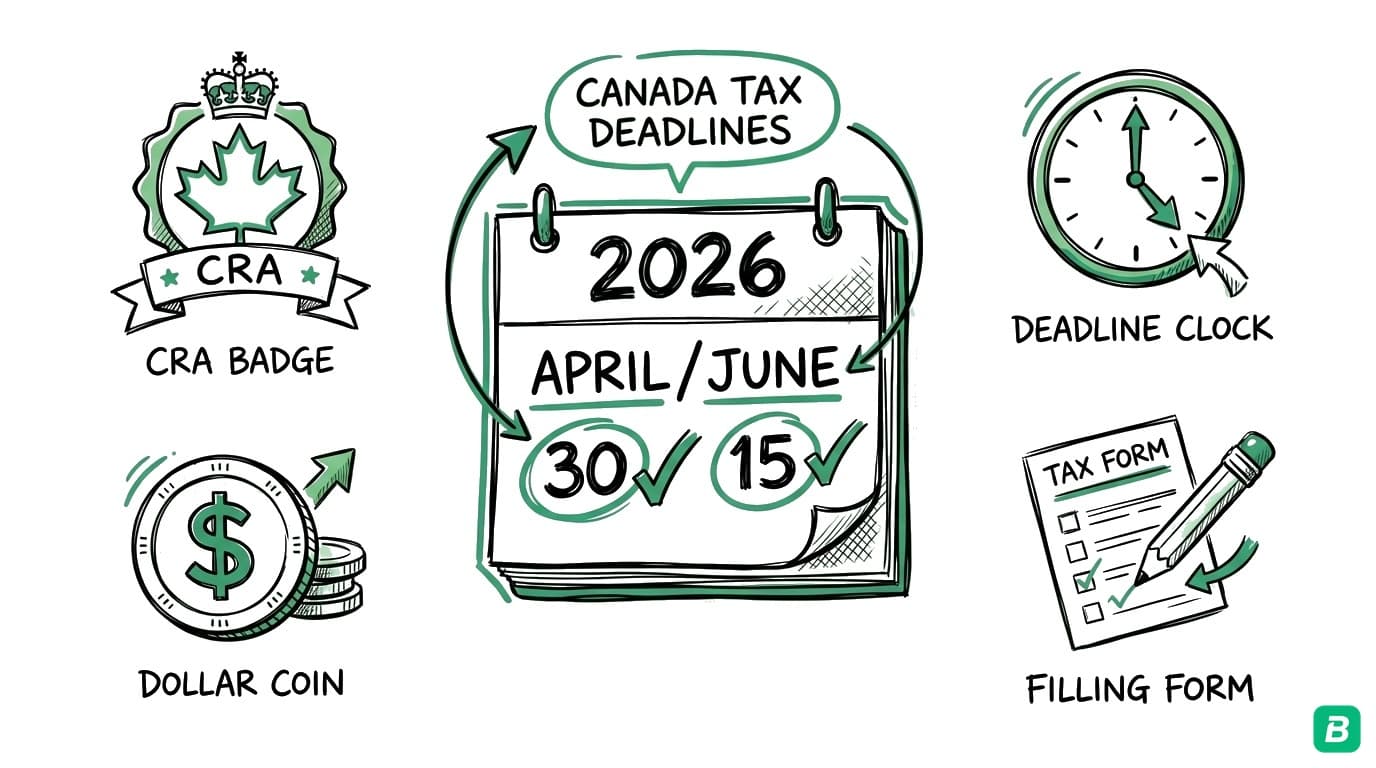
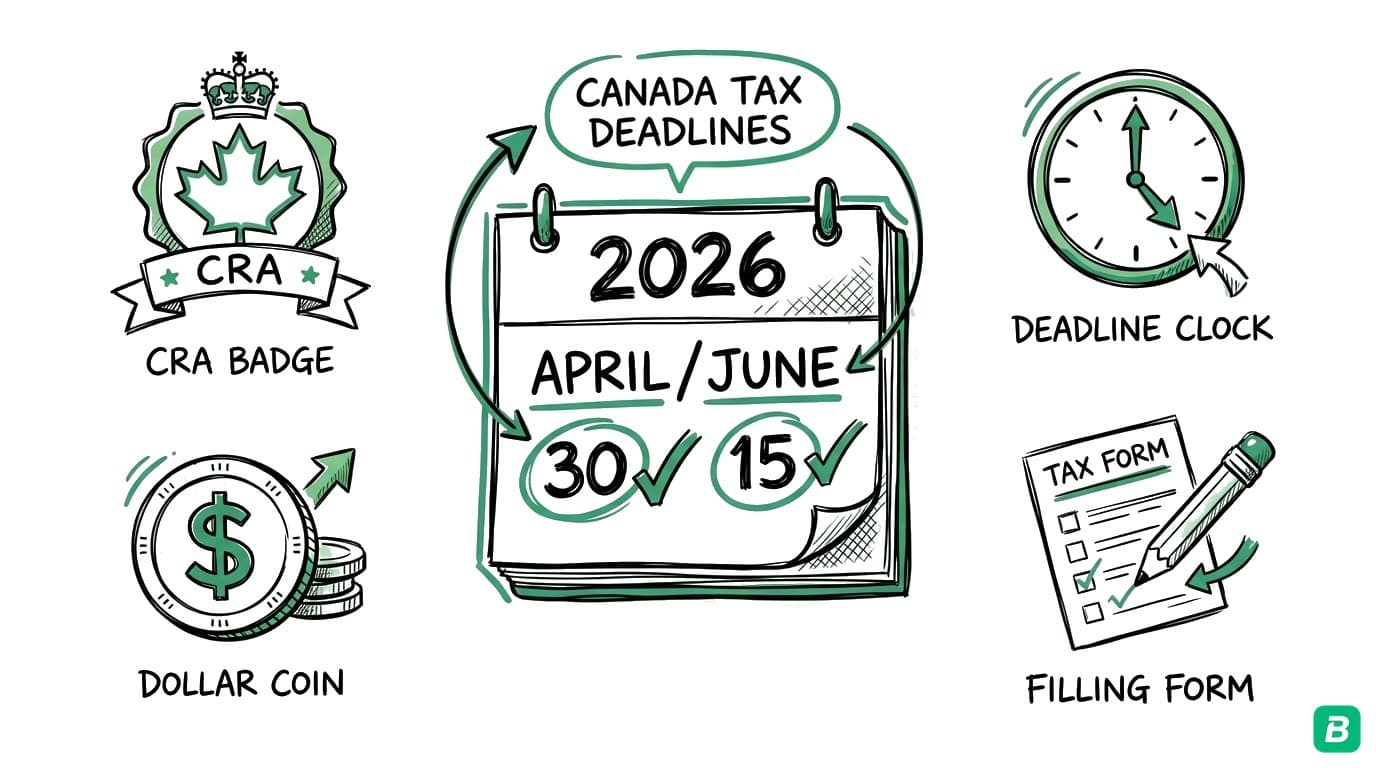
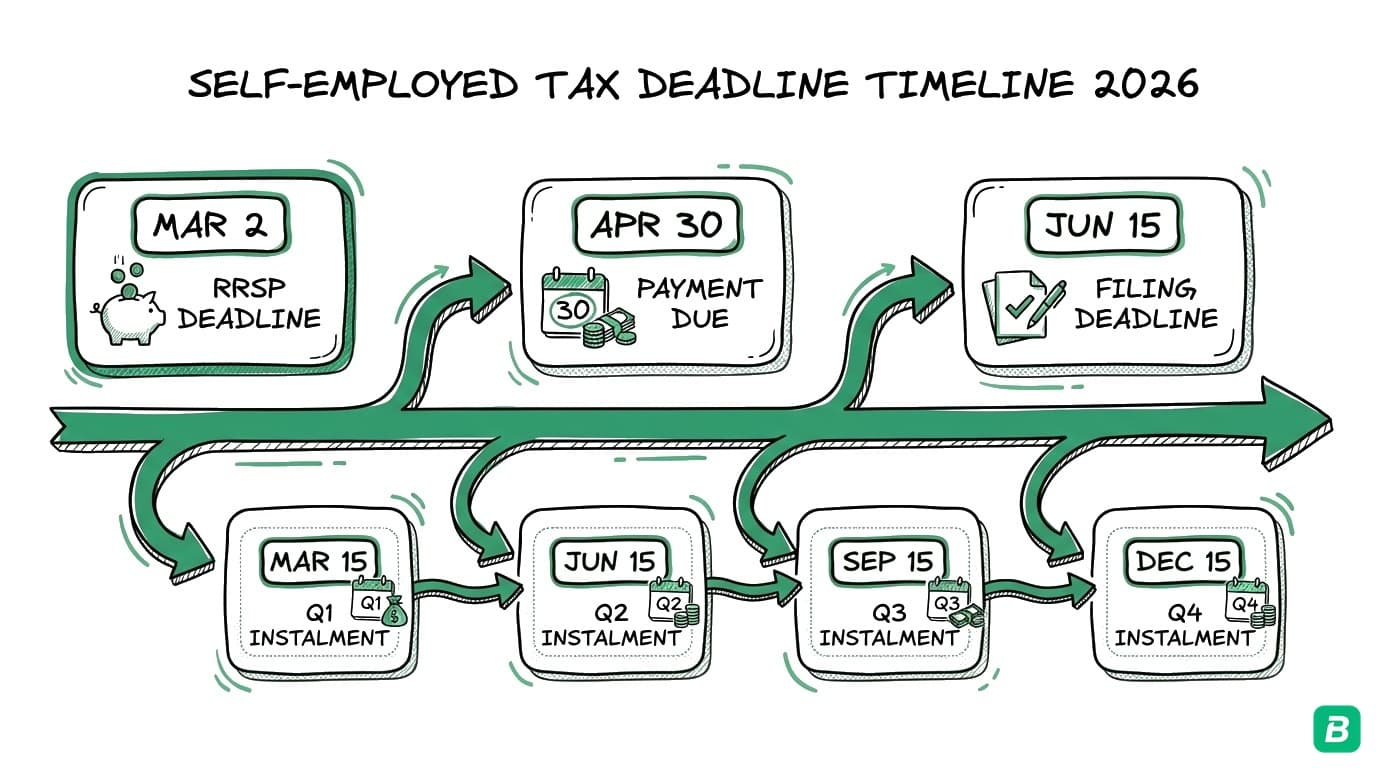
- April 30, 2026 is the payment deadline for almost everyone — including self-employed filers
- June 15, 2026 is the filing deadline only for self-employed individuals (but interest starts May 1)
- Quarterly instalment dates: March 15, June 15, September 15, December 15
- Late filing penalty: 5% of balance owing + 1% per month (up to 12 months)
- Repeat offenders face 10% + 2% per month (up to 20 months)
Missing a single CRA deadline can cost you hundreds — or thousands — in penalties and interest. This guide covers every Canada tax deadline in 2026 for personal filers, self-employed workers, corporations, and GST/HST registrants. Bookmark this page and check back throughout the year so you never miss a date.
Personal Income Tax Deadlines 2026
These deadlines apply to all Canadian residents filing a T1 General return for the 2025 tax year.
| Deadline | Date | Who It Applies To |
|---|---|---|
| RRSP contribution deadline | March 2, 2026 | Anyone claiming RRSP deductions for 2025 |
| T1 filing deadline | April 30, 2026 | All individual taxpayers |
| Balance owing payment | April 30, 2026 | Anyone who owes taxes for 2025 |
| Self-employed filing | June 15, 2026 | Self-employed individuals and their spouses |
April 30, 2026 — Filing and Payment Deadline
The standard deadline to file your personal income tax return and pay any balance owing is Thursday, April 30, 2026. This applies to employees, retirees, investors, and anyone filing a T1 return.
If you owe taxes and do not pay by April 30, the CRA charges compound daily interest on the unpaid amount starting May 1. The prescribed interest rate for 2026 Q1 is 8% per annum on overdue amounts, compounded daily.
March 2, 2026 — RRSP Contribution Deadline
To claim an RRSP deduction on your 2025 return, contributions must be made by the first 60 days of 2026. Since day 60 falls on a Sunday (March 1), the effective deadline is Monday, March 2, 2026.
Your RRSP deduction limit for 2025 is 18% of your 2024 earned income, up to a maximum of $32,490, minus any pension adjustments. Check your Notice of Assessment or CRA My Account for your exact limit.
Contributing more than $2,000 beyond your limit triggers a penalty of 1% per month on the excess amount. If you are unsure of your room, check your CRA My Account before contributing — the penalty compounds quickly.
June 15, 2026 — Self-Employed Filing Deadline
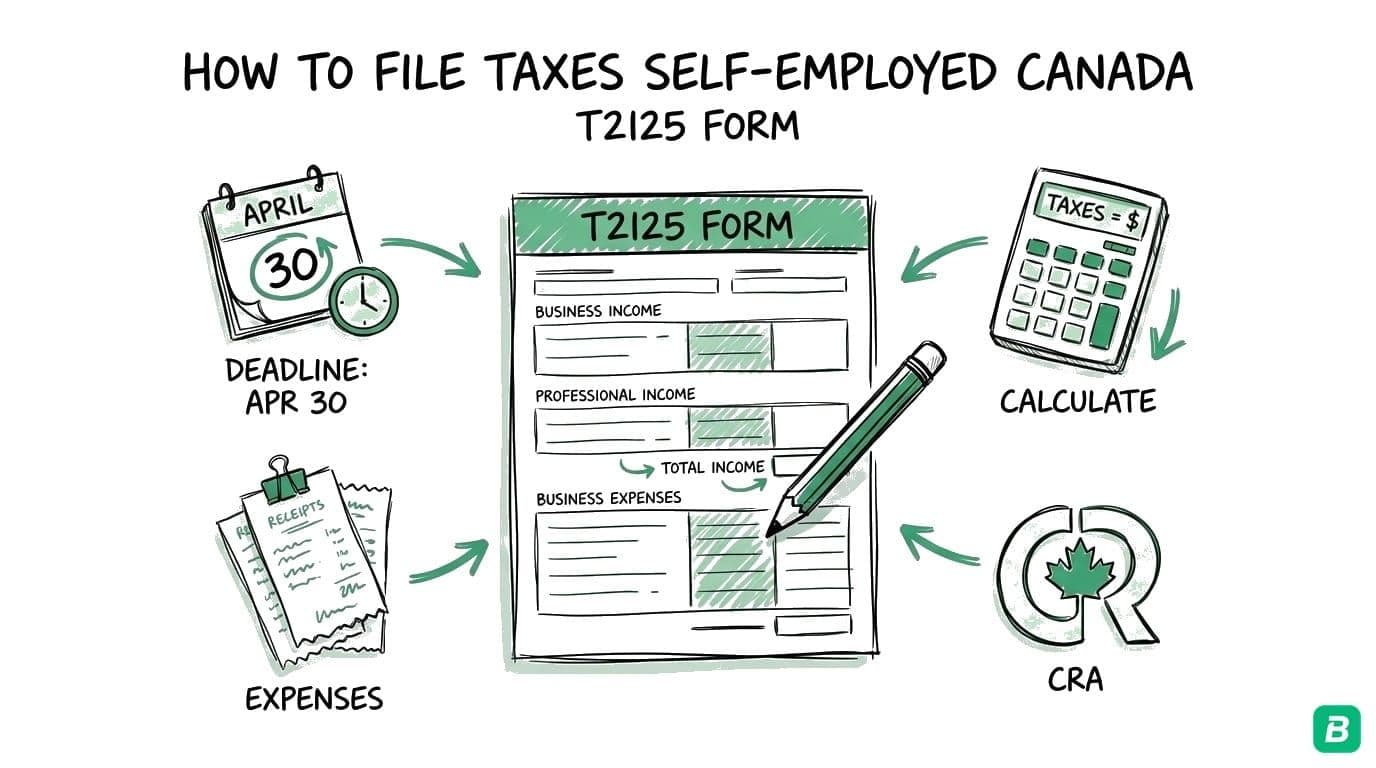
If you or your spouse earned self-employment income in 2025, the filing deadline is extended to Monday, June 15, 2026. This applies to sole proprietors, freelancers, gig workers, and anyone who filed a T2125 Statement of Business or Professional Activities.
But here is the catch most people miss: the payment deadline is still April 30. Filing is extended. Payment is not. If you owe money and wait until June 15 to pay, the CRA charges compound daily interest on your balance starting May 1 — even though your return is not technically late.
If you cannot pay by April 30, file your return anyway. The late-filing penalty (5% + 1%/month) only applies if you owe and file late. Filing on time and paying late means you only owe interest, not the penalty. That difference can save you hundreds of dollars.
For a complete walkthrough of the self-employed filing process, see our guide to filing taxes as a self-employed Canadian.
Self-Employed and Freelancer Tax Deadlines 2026
Self-employed Canadians face more deadlines than salaried employees. Beyond the April 30 and June 15 dates, you need to track CPP contributions, GST/HST remittances, and quarterly instalments.
CPP Contributions for Self-Employed
As a self-employed worker, you pay both the employee and employer portions of Canada Pension Plan contributions. For 2025 (filed in 2026):
- CPP base contribution rate: 11.90% (both portions combined) on pensionable earnings between $3,500 and $71,300
- CPP2 rate: 8% on earnings between $71,300 and $81,200 (second ceiling)
- Maximum CPP contribution: approximately $8,068.20 (base) + $792 (CPP2)
CPP is calculated on your T1 return and included in your balance owing — no separate deadline. But knowing these amounts helps you plan your April 30 payment.
Record Keeping Requirements
The CRA requires self-employed individuals to keep business records for six years from the end of the tax year. This includes receipts, invoices, bank statements, contracts, and vehicle logs.
If the CRA audits you and you cannot produce records, they can deny deductions entirely — even legitimate ones. For practical advice on organizing your records, see our year-end tax checklist for self-employed Canadians.
GST/HST Filing Deadlines 2026
If your business is registered for GST/HST (mandatory once revenue exceeds $30,000 in a 12-month period), you have separate remittance deadlines depending on your filing frequency.
Annual Filers
| Fiscal Year-End | Filing Deadline | Payment Deadline |
|---|---|---|
| December 31, 2025 (individuals) | June 15, 2026 | April 30, 2026 |
| December 31, 2025 (corporations) | March 31, 2026 | March 31, 2026 |
Most sole proprietors file GST/HST annually. If your fiscal year ends December 31, your GST/HST return is due June 15, 2026 — but the payment is due April 30, 2026. The same April 30 / June 15 split that applies to income tax also applies here.
Quarterly Filers
Businesses with annual revenue between $1.5 million and $6 million must file quarterly. Businesses under $1.5 million can elect to file quarterly.
| Reporting Period | Filing & Payment Deadline |
|---|---|
| January 1 – March 31, 2026 | April 30, 2026 |
| April 1 – June 30, 2026 | July 31, 2026 |
| July 1 – September 30, 2026 | October 31, 2026 |
| October 1 – December 31, 2026 | January 31, 2027 |
Monthly Filers
Businesses with annual revenue over $6 million must file monthly. The return and payment are due one month after the end of each reporting period (e.g., January 2026 is due March 2, 2026 because February 28 falls on a Saturday).
If your annual taxable revenue (including GST/HST) is $400,000 or less, you may qualify for the Quick Method. Instead of tracking ITCs on every purchase, you remit a fixed percentage of revenue. It simplifies filing significantly and often results in paying less GST/HST overall.
Quarterly Tax Instalment Deadlines 2026
The CRA requires instalment payments if your net tax owing is above $3,000 in the current year and either of the two preceding years ($1,800 in Quebec).
2026 Instalment Due Dates
| Instalment | Due Date | Notes |
|---|---|---|
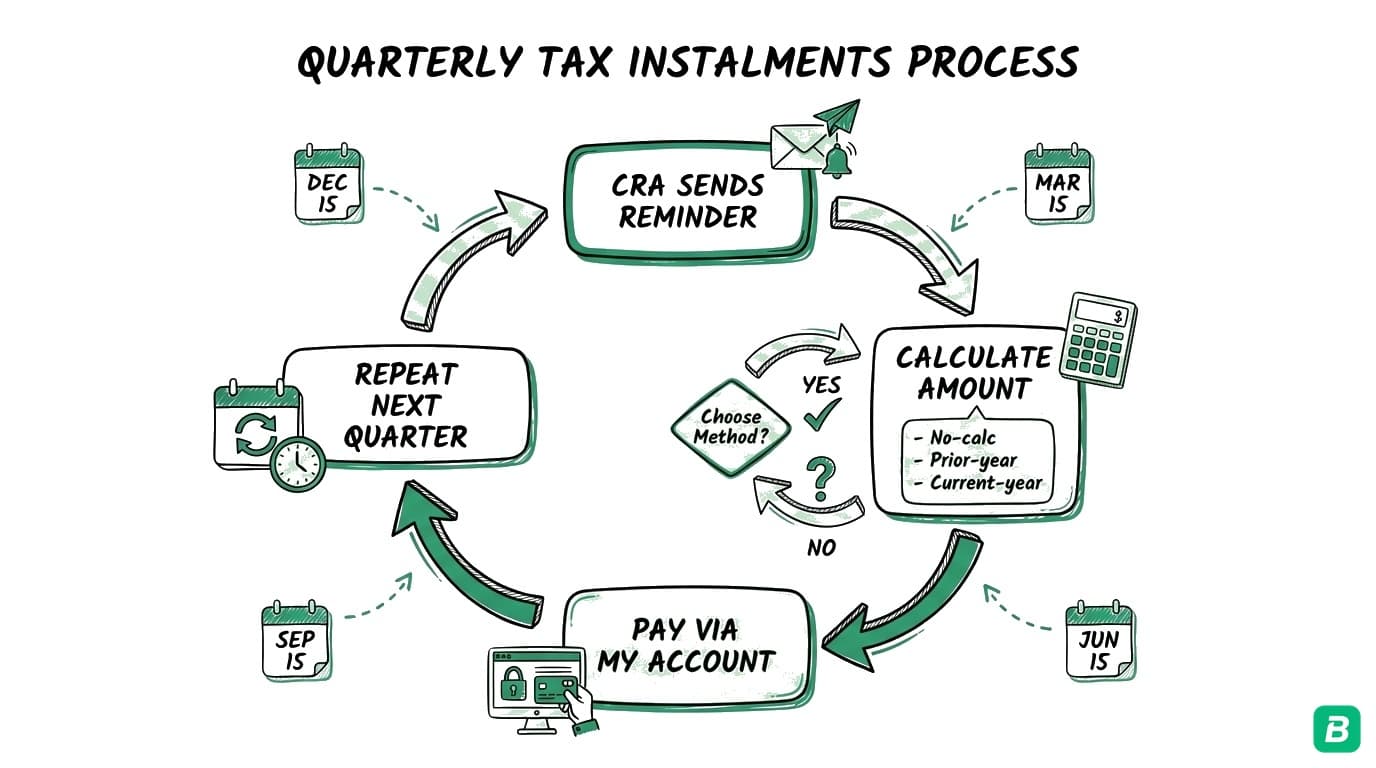
| Q1 | March 15, 2026 (Sunday → March 16) | Based on prior-year tax |
| Q2 | June 15, 2026 | Also self-employed filing deadline |
| Q3 | September 15, 2026 | Mid-year — review estimate |
| Q4 | December 15, 2026 | Final instalment before year-end |
Three Methods to Calculate Instalments
The CRA provides three calculation methods. You can use whichever results in the lowest payment, but you risk instalment interest if you underpay:
- No-calculation method: Use the amounts on the CRA instalment reminder (form INNS-1). Simplest, but may overestimate if your income dropped.
- Prior-year method: Base each instalment on 25% of your 2025 net tax owing. Good if your income is stable year over year.
- Current-year method: Base each instalment on 25% of your estimated 2026 net tax owing. Best if you expect lower income, but risky if you underestimate.
Instalment Interest and Penalties
If your instalment payments are insufficient, the CRA charges instalment interest at the prescribed rate (currently 8% per annum, compounded daily). If instalment interest exceeds $1,000, you may also face a 50% penalty on the interest amount exceeding $1,000.
Many freelancers and gig workers are surprised by instalment requirements in their second year of business. If you owed more than $3,000 on your first tax return, CRA will send instalment reminders. Ignoring them does not make the obligation go away — it just adds interest.
Corporate Tax Deadlines 2026
Canadian-controlled private corporations (CCPCs) follow different deadlines based on their fiscal year-end.
Filing Deadlines
Corporate T2 returns are due six months after the end of the fiscal year:
| Fiscal Year-End | T2 Filing Deadline |
|---|---|
| December 31, 2025 | June 30, 2026 |
| March 31, 2026 | September 30, 2026 |
| June 30, 2026 | December 31, 2026 |
| September 30, 2026 | March 31, 2027 |
Payment Deadlines
Corporate tax payments are due two months after the fiscal year-end for most CCPCs (or three months if the corporation qualifies for the small business deduction and its prior-year taxable income was under $500,000).
| Fiscal Year-End | Payment Deadline (2 months) | Payment Deadline (3 months — SBD) |
|---|---|---|
| December 31, 2025 | March 2, 2026 | March 31, 2026 |
| March 31, 2026 | May 31, 2026 | June 30, 2026 |
| June 30, 2026 | August 31, 2026 | September 30, 2026 |
Corporate Instalment Requirements
Corporations owing more than $3,000 in federal tax must pay monthly instalments. These are due on the last day of each month. For CCPCs qualifying for the small business deduction with taxable income under $500,000 in the prior year, quarterly instalments are permitted.
Employer Remittance Deadlines 2026
If you have employees, you must remit source deductions (income tax, CPP, EI) to the CRA by specific deadlines.
| Remitter Type | Threshold | Due Date |
|---|---|---|
| Regular (new or small) | Average monthly withholding under $25,000 | 15th of the following month |
| Accelerated — Threshold 1 | $25,000 – $99,999.99 | 25th (for first 15 days) and 10th (for rest of month) |
| Accelerated — Threshold 2 | $100,000+ | 3 business days after pay date |
Key Employer Dates
| Date | Obligation |
|---|---|
| February 28, 2026 | Issue T4, T4A, T5 slips to employees and recipients |
| February 28, 2026 | File T4, T4A, T5 information returns with CRA |
| March 31, 2026 | File T3 trust returns (December 31 year-end trusts) |
Other Important Tax Dates 2026
| Date | What | Who |
|---|---|---|
| January 15, 2026 | First quarterly instalment reminder issued by CRA | All instalment payers |
| February 28, 2026 | T4/T4A/T5 slips issued | Employers and investment issuers |
| March 2, 2026 | RRSP contribution deadline for 2025 | Individual filers |
| March 15, 2026 | First quarterly instalment | Instalment payers |
| April 30, 2026 | T1 personal return + payment | All individuals |
| April 30, 2026 | GST/HST payment (annual filers) | Registered sole proprietors |
| June 15, 2026 | Self-employed filing deadline | Self-employed and spouses |
| June 15, 2026 | GST/HST filing deadline (annual individual filers) | Registered sole proprietors |
| June 15, 2026 | Second quarterly instalment | Instalment payers |
| June 30, 2026 | T2 corporate filing (Dec 31 year-end) | Corporations |
| September 15, 2026 | Third quarterly instalment | Instalment payers |
| December 15, 2026 | Fourth quarterly instalment | Instalment payers |
| December 31, 2026 | Last day to make tax-deductible purchases for 2026 | All businesses |
Late Filing Penalties and Interest
The CRA does not give grace periods. Missing a deadline triggers automatic penalties and interest that compound quickly.
Late Filing Penalty
If you owe taxes and file after the deadline, the CRA charges:
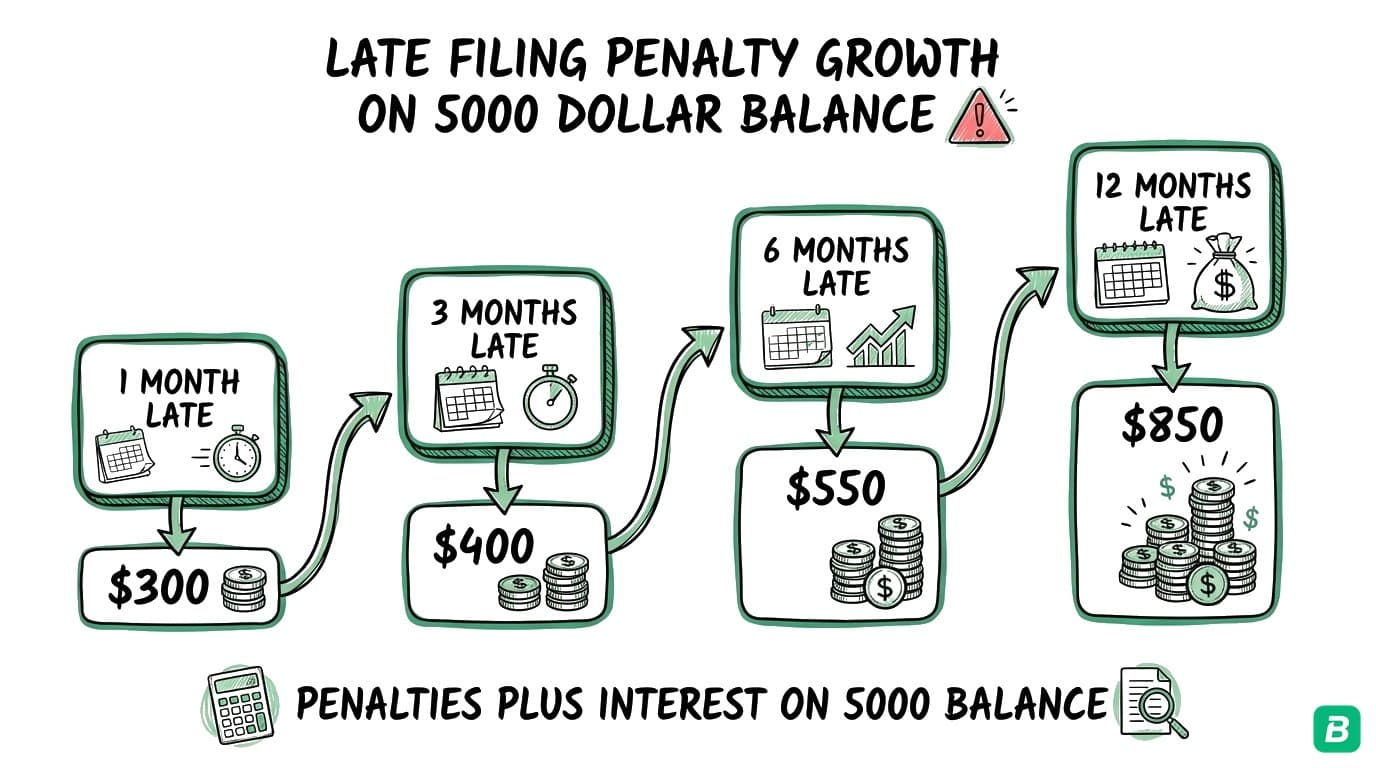
- 5% of your balance owing, plus
- 1% per additional month you are late (maximum 12 months)
- Maximum: 5% + 12% = 17% of your balance for filing 12 months late
Example: You owe $5,000 and file 6 months late.
- Penalty = 5% + (1% × 6) = 11% × $5,000 = $550 in penalties alone
Repeat Offender Penalty
If the CRA charged you a late-filing penalty in any of the three preceding years, the penalty doubles:
- 10% of your balance owing, plus
- 2% per additional month (maximum 20 months)
- Maximum: 10% + 40% = 50% of your balance
A freelancer who filed late in 2024 and files late again in 2026 with a $10,000 balance could face a penalty of $1,000 (10%) plus $200/month. After 12 months: $3,400 in penalties on top of interest. File on time, even if you cannot pay.
Late Payment Interest
Even if you file on time, unpaid balances accrue compound daily interest at the CRA prescribed rate. As of Q1 2026, the rate is 8% per annum on overdue amounts. This rate is reviewed quarterly and has been at or above 7% since 2023.
GST/HST Penalties
Late GST/HST returns have their own penalty structure:
- 1% of the balance owing, plus
- 0.25% per additional month (maximum 12 months)
- Maximum: 1% + 3% = 4% of balance for filing 12 months late
GST/HST penalties are lower than income tax penalties, but the interest rate is the same.
Provincial Considerations
While federal deadlines are the same across Canada, some provinces have additional requirements.
Quebec (Revenu Québec)
Quebec residents file a separate provincial return with Revenu Québec. Key differences:
- Filing deadline: Same as federal (April 30 or June 15 for self-employed)
- Instalment threshold: $1,800 net tax owing (lower than the federal $3,000 threshold)
- QST: Filed separately from GST (not combined like HST in other provinces)
- RL-1 slips: Replace T4 slips for Quebec employers — due February 28, 2026
Alberta
Alberta has no provincial sales tax, so there are no additional PST remittance deadlines. Alberta residents follow all federal deadlines.
British Columbia
BC PST is collected and remitted separately from GST. If your business collects BC PST, remittance deadlines depend on your filing frequency (monthly, quarterly, or annually) and are managed by the BC Ministry of Finance.
Saskatchewan and Manitoba
Both provinces have separate PST regimes with their own remittance schedules. If you operate in these provinces, check your provincial tax authority for specific deadlines.
How to Never Miss a Tax Deadline
1. Set Up CRA My Account
CRA My Account shows your RRSP room, instalment requirements, notices of assessment, and payment history. Set up direct deposit to receive refunds faster and enable email notifications for new mail.
2. Use Calendar Reminders
Set recurring reminders two weeks before each deadline. Key dates to add:
- February 15: Reminder to gather T4/T5 slips, prepare RRSP contribution
- March 1: RRSP contribution deadline (day before March 2)
- April 15: Two weeks before April 30 payment/filing deadline
- June 1: Two weeks before June 15 filing deadline (self-employed)
- March 1, June 1, September 1, December 1: Instalment reminders
3. Track Expenses Year-Round
The biggest delay in tax filing is not knowing your numbers. If you track expenses throughout the year instead of reconstructing everything in April, filing becomes a matter of reviewing and submitting — not a week-long project.
BookZero scans receipts with AI, auto-categorizes expenses to CRA T2125 categories, and separates GST/HST automatically. When tax time arrives, your numbers are already organized.
4. Make Estimated Payments Throughout the Year
Even if you are not required to pay instalments, setting aside 25–30% of each invoice into a separate savings account prevents the April 30 shock. Many freelancers owe $5,000–$15,000 at tax time because they did not plan for income tax, CPP, and GST/HST together.
5. Maximize Deductions Before Deadlines
Some deductions have their own deadlines:
| Deduction | Deadline |
|---|---|
| RRSP contributions (2025 tax year) | March 2, 2026 |
| Business purchases (2026 tax year) | December 31, 2026 |
| Home office expenses (2025 tax year) | Claimed on T2125 filed by June 15, 2026 |
| Vehicle expenses (2025 tax year) | Claimed on T2125 filed by June 15, 2026 |
For a full list of deductions available to self-employed Canadians, see our guide to small business tax deductions in Canada.
Gig Worker Deadlines: Uber, DoorDash, and Delivery Drivers
Gig workers — Uber drivers, DoorDash couriers, Instacart shoppers, and other platform workers — are self-employed for tax purposes. Every deadline in this guide applies to you.
Key points for gig workers:
- You must file if you earned any amount. There is no minimum income threshold for filing when you are self-employed.
- GST/HST registration is mandatory once your gross revenue (not profit) exceeds $30,000 in any rolling 12-month period. Uber drivers often hit this threshold faster than expected because it is based on gross fares, not your net after Uber's commission.
- Vehicle expenses are your largest deduction. Keep a vehicle log tracking business vs. personal kilometres. The CRA requires this log to claim vehicle expenses — estimates are not accepted in an audit.
- Platform tax documents: Uber, DoorDash, and similar platforms issue tax summaries in February. These are not T4 slips — they are informational. You are responsible for reporting the correct income amount on your T2125.
For platform-specific guidance, see our guides for Uber driver tax deductions and DoorDash and Uber Eats tax deductions.
Month-by-Month 2026 Tax Calendar
January 2026
- CRA mails T4, T5, and other information slips to taxpayers
- Review prior year financials and start gathering documents
- CRA issues first instalment reminders
February 2026
- February 28: T4/T4A/T5 slips due from employers
- Receive all tax slips and begin preparing returns
- Ensure RRSP contribution room is confirmed via CRA My Account
March 2026
- March 2: RRSP contribution deadline for 2025
- March 15 (16): First quarterly instalment due
- Begin preparing T1 and T2125 returns
April 2026
- April 30: Personal T1 filing deadline + balance owing payment
- April 30: GST/HST annual payment (individual filers)
- April 30: First quarterly GST/HST return (quarterly filers)
May 2026
- Interest begins accruing on unpaid balances
- Review CRA Notice of Assessment when received
- Confirm instalments are set up for June
June 2026
- June 15: Self-employed T1 filing deadline
- June 15: GST/HST annual filing deadline (individual filers)
- June 15: Second quarterly instalment
- June 30: T2 corporate filing (December 31 year-end)
July – August 2026
- July 31: Second quarterly GST/HST return
- Mid-year review of instalment amounts
- Adjust current-year estimates if income has changed
September 2026
- September 15: Third quarterly instalment
- Begin year-end tax planning for 2026
- Review potential asset purchases before December 31
October – November 2026
- October 31: Third quarterly GST/HST return
- Start closing 2026 books
- Follow our year-end tax checklist
December 2026
- December 15: Fourth quarterly instalment
- December 31: Last day for tax-deductible business purchases
- December 31: Fiscal year-end for most sole proprietors
- Finalize records and prepare for January filing season
Frequently Asked Questions
What happens if I miss the April 30 tax deadline in Canada?
If you owe taxes and file after April 30, the CRA charges a late-filing penalty of 5% of your balance owing plus 1% for each additional month you are late, up to 12 months. Interest also accrues at 8% per annum (compounded daily) on any unpaid balance starting May 1. If you do not owe taxes, there is no penalty for late filing — but you may delay receiving your refund or benefit payments.
When are taxes due in Canada for self-employed workers?
Self-employed individuals in Canada have until June 15, 2026 to file their tax return, but any balance owing must still be paid by April 30, 2026. This means you have extra time to prepare your T2125 form, but CRA charges compound daily interest on unpaid amounts starting May 1 — even though your return is not technically late until June 16.
Do I need to pay quarterly tax instalments in Canada?
You must pay quarterly instalments if your net tax owing exceeds $3,000 in the current year and in either of the two preceding years ($1,800 if you live in Quebec). The CRA will send you instalment reminders (form INNS-1) with suggested amounts. Missing instalment payments results in interest charges, and if the interest exceeds $1,000, an additional 50% penalty on the excess.
What is the GST/HST filing deadline for 2026?
For sole proprietors filing annually with a December 31 year-end, the GST/HST return is due June 15, 2026, but payment is due April 30, 2026. Quarterly filers must file and pay one month after each quarter ends. Monthly filers must file and pay one month after each month ends. The filing deadline depends on your assigned filing frequency, which is based on your annual taxable revenue.
Can I get an extension on my Canadian tax return?
The CRA does not grant filing extensions for personal T1 returns. The deadlines (April 30 or June 15 for self-employed) are fixed by law. However, if you cannot pay the full amount by April 30, you can file your return on time and arrange a payment plan with the CRA to avoid the late-filing penalty. Contact the CRA at 1-888-863-8662 to discuss payment arrangements before the deadline.
What tax deadlines apply to corporations in Canada?
Canadian corporations must file a T2 corporate return within six months of their fiscal year-end. Tax payments are due two months after the fiscal year-end (three months for CCPCs eligible for the small business deduction with prior-year taxable income under $500,000). Corporations owing more than $3,000 in federal tax must make monthly instalments.
Stay on Top of Every Deadline
Canada tax deadlines in 2026 are not optional — the CRA enforces penalties automatically, without warning. Whether you are an employee filing a simple T1 or a self-employed freelancer juggling income tax, CPP, GST/HST, and quarterly instalments, the cost of missing a deadline ranges from annoying to financially devastating.
The best defence is year-round preparation. Track your expenses as they happen, set calendar reminders for every deadline, and file early even if you cannot pay in full. The penalties for late filing are always worse than the interest on late payment.
Ready to get your 2026 bookkeeping organized? Try BookZero free — AI-powered receipt scanning, automatic CRA categorization, and GST/HST separation so your numbers are tax-ready year-round.

Eric Tech· Founder, BookZero.ai
Founder of BookZero. Building AI-powered bookkeeping tools for US and Canadian freelancers and small businesses.
View all postsStay ahead of tax season
Tax tips, deduction strategies, and feature announcements straight to your inbox. No spam, unsubscribe anytime.