1099 Write-Offs: A Schedule C List for Freelancers and Contractors
The common 1099 write-offs for freelancers and independent contractors, sorted by Schedule C line, with the IRS rules for mileage, home office, meals and equipment, and the records to keep.
 Eric Tech·Oct 21, 2026·13 min read·
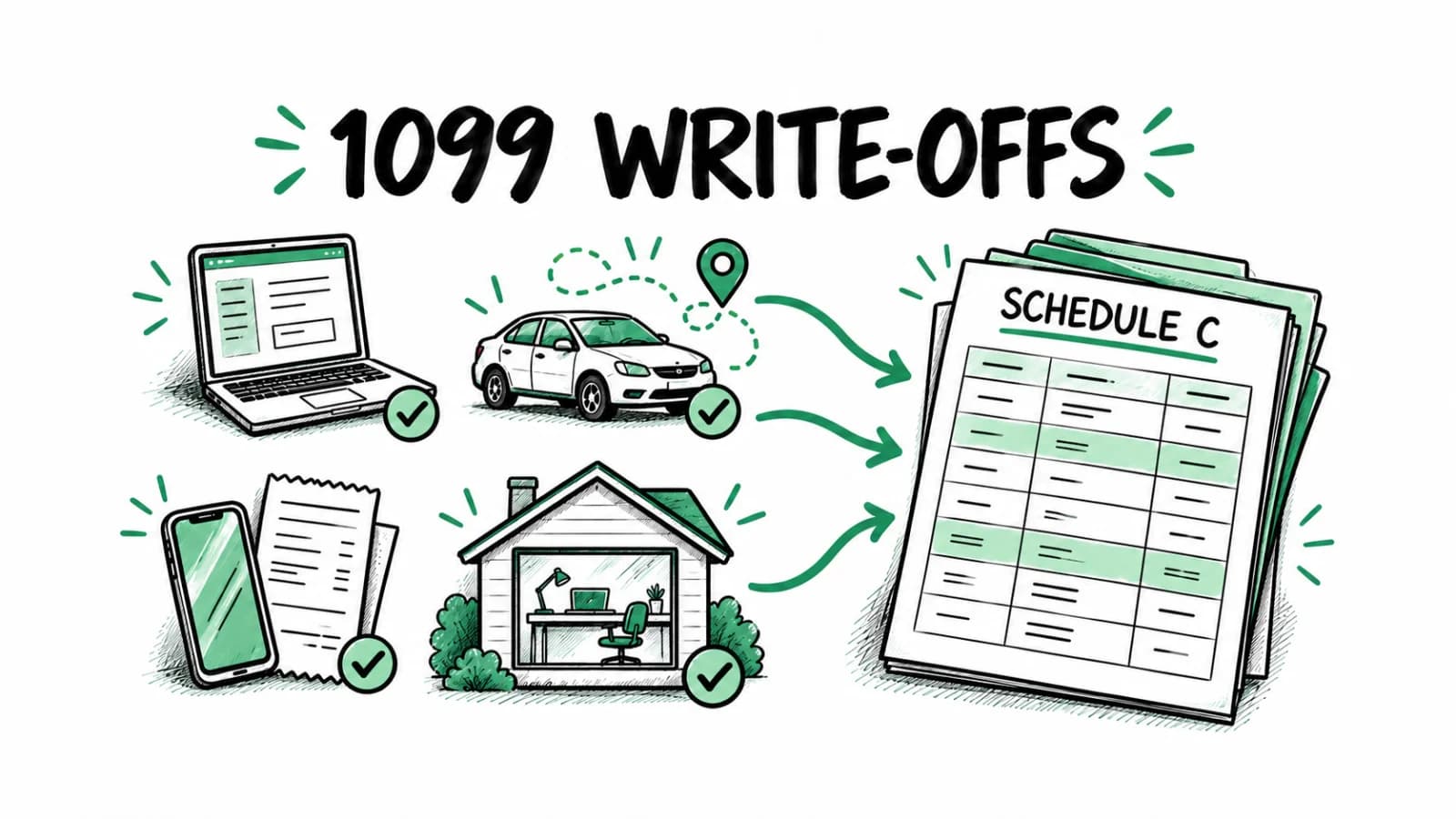
1099 write-offs are the business expenses a freelancer or independent contractor deducts on Schedule C. They lower your net profit, and so both your income tax and your 15.3% self-employment tax. The common ones are software, office supplies, your phone and internet (business share), business mileage, a home office, contract labor, platform fees, insurance, travel and half of business meals. Each one needs a receipt and a business reason.
The list below follows the 2025 Schedule C lines, with the IRS rule each one carries.
What Counts as a 1099 Write-Off
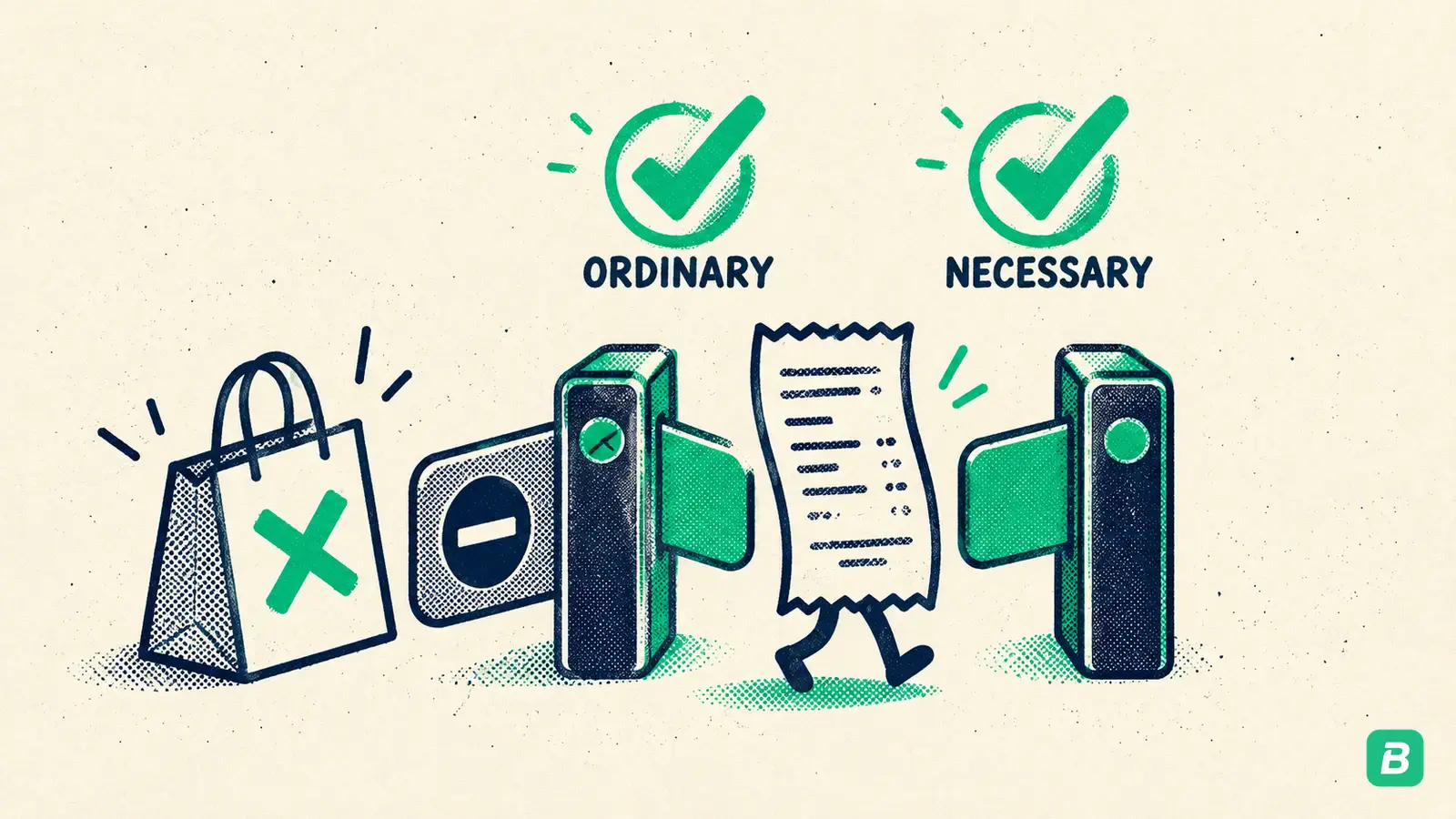
The IRS lets you deduct business expenses that are ordinary and necessary. In Publication 334, "an ordinary expense is one that is common and accepted in your field of business," and "a necessary expense is one that is helpful and appropriate for your business." It doesn't have to be indispensable.
Three things follow from that:
- Business, not personal. Groceries, your own clothes and a family phone plan are personal. A cost used for both gets split, and only the business share counts.
- Paid by you, for your business. A client who reimburses you is not your expense.
- Proved by a record. A receipt or invoice, plus a note of the business purpose when the receipt doesn't make it obvious.
As a 1099 contractor you report your income and these expenses on Schedule C. If your net earnings from self-employment are $400 or more, you also owe self-employment tax at 15.3% (12.4% Social Security and 2.9% Medicare), figured on Schedule SE.
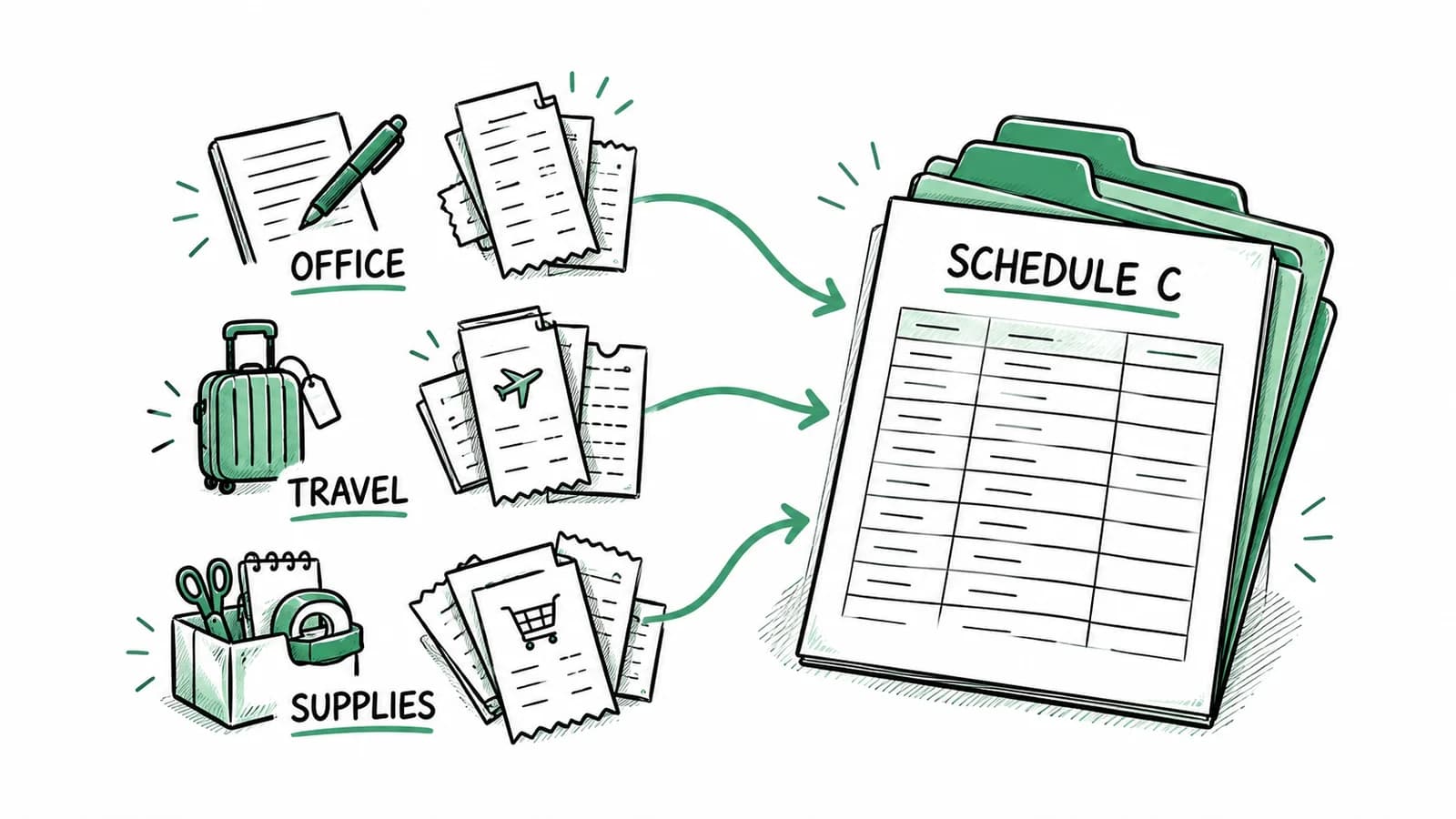
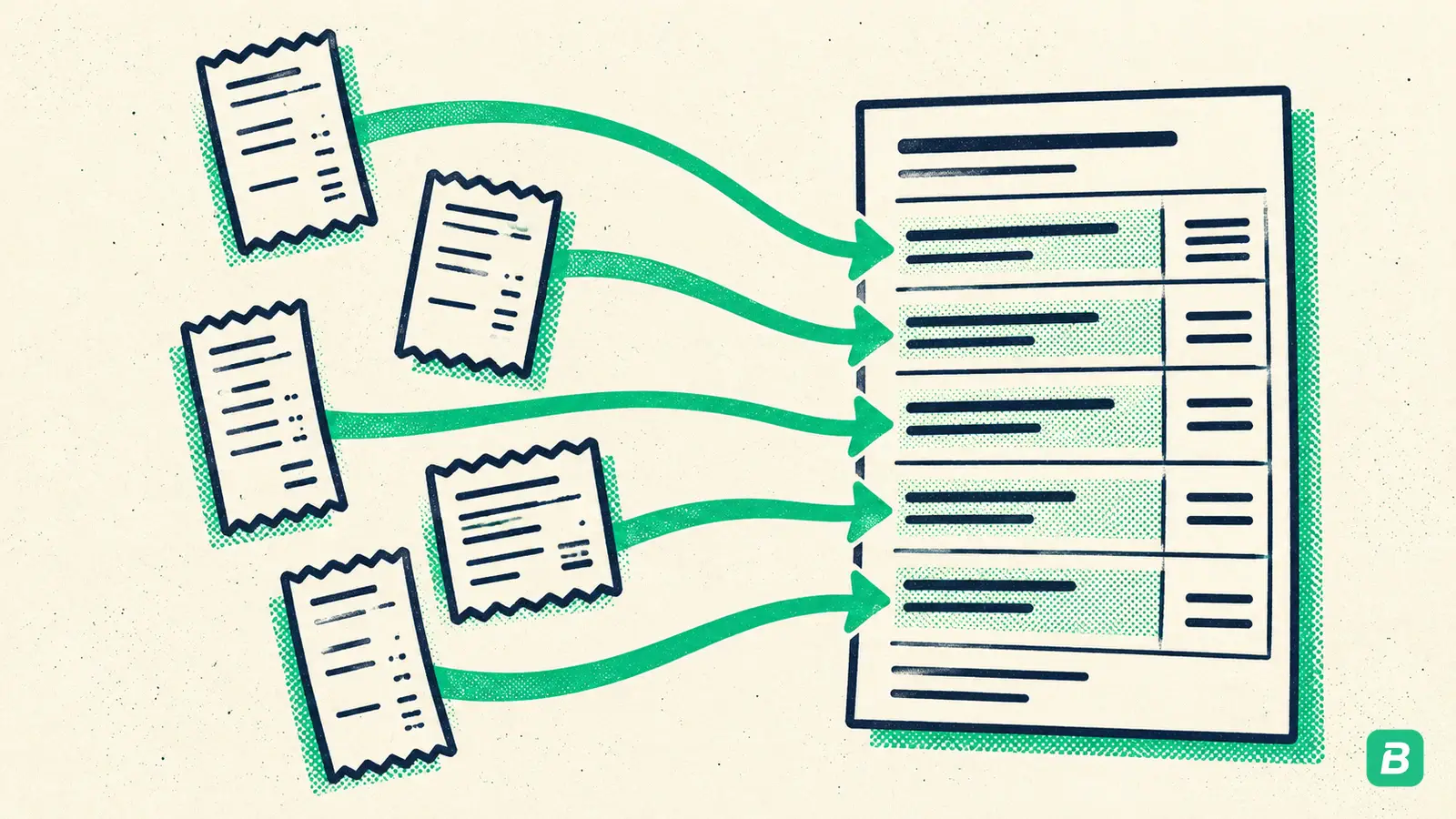
1099 Write-Offs List by Schedule C Line
These are the categories BookZero uses for US businesses, with the 2025 Schedule C line each one lands on. For 2025, Other expenses moved to line 27b.
| Category | Sch. C line | Examples | The rule to know |
|---|---|---|---|
| Advertising | 8 | Google or Meta ads, business cards, flyers | Website hosting counts here only when it is promotional |
| Car and truck expenses | 9 | Gas, repairs, tires, car insurance, registration | Actual-expense method only, business share by miles; the standard mileage rate already covers these |
| Parking and tolls | 9 | Parking at a client, bridge or highway tolls | Deductible under either vehicle method; parking at your regular workplace is commuting |
| Commissions and fees | 10 | Uber, Lyft or DoorDash service fees, Stripe, Square or PayPal fees, marketplace commissions | The IRS names no line for platform fees; line 10 is our reading |
| Contract labor | 11 | A freelancer you hired, an Upwork contractor | People you pay as contractors, not employees |
| Depreciation and section 179 | 13 | A laptop over $2,500, a camera, machinery | Claimed through Form 4562, not as a current expense |
| Insurance (other than health) | 15 | Liability or professional insurance | Car insurance goes on line 9; your own health insurance is not a Schedule C expense |
| Interest | 16b | Business share of car-loan or business credit card interest | Allowed with either vehicle method |
| Legal and professional services | 17 | Bookkeeper, accountant, lawyer, tax prep | Fees to buy business property are added to its cost |
| Office expense | 18 | Paper, printer ink, postage | Software subscriptions go on Other expenses |
| Rent or lease (machinery and equipment) | 20a | A rented camera or tool | A leased vehicle has its own rules |
| Rent or lease (other business property) | 20b | A co-working desk, a studio, a storage unit | Rent on your own home goes on line 30 instead |
| Repairs and maintenance | 21 | Fixing business equipment | Vehicle repairs go on line 9 |
| Supplies | 22 | Materials used up in your work, safety gear | Groceries for yourself are personal |
| Taxes and licenses | 23 | A city business license, a state permit | Paid to a state or local government |
| Travel | 24a | Flights, hotels and rides on a business trip | Meals on the trip go on line 24b |
| Deductible meals | 24b | A meal with a client, meals while traveling for work | 50% in most cases; entertainment is not deductible |
| Utilities | 25 | Your phone bill, internet (business share) | Other home utilities go on line 30 |
| Business use of home | 30 | The workspace share of rent, utilities and insurance | Form 8829, or the simplified method |
| Other expenses | 27b | Software and SaaS, bank fees, training, professional dues, equipment of $2,500 or less | Listed item by item in Part V |
Wages (line 26) and Employee benefit programs (line 14) apply once you hire employees. Lines that rarely apply to a freelancer, such as depletion, are left out.
Write-Offs That Need Extra Care
Car and mileage
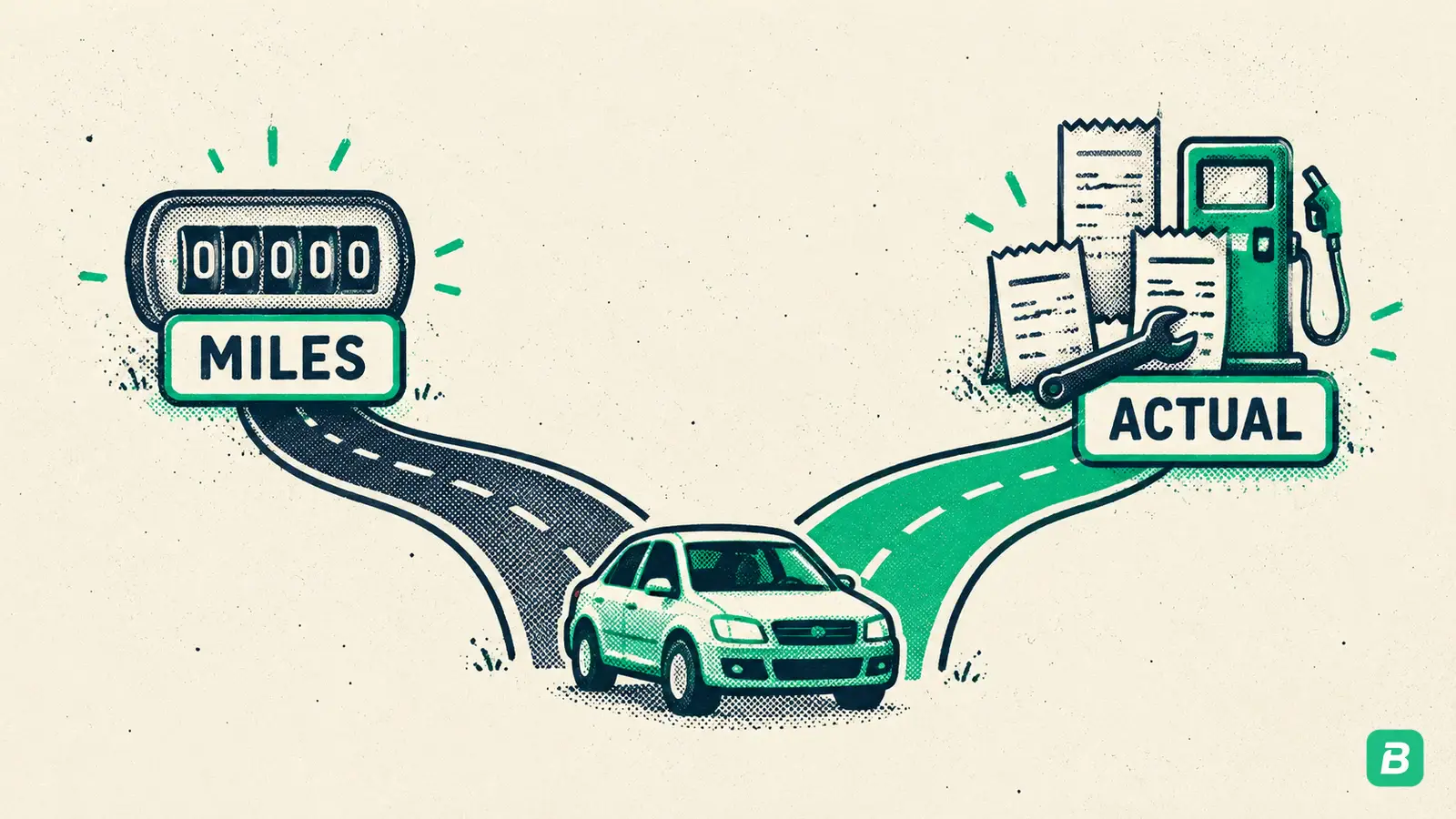
You pick one of two methods for each vehicle.
- Standard mileage rate. Multiply your business miles by the IRS rate. It was 70 cents a mile for 2025. For 2026 it is 72.5 cents for miles driven January 1 to June 30, and 76 cents from July 1, after a midyear increase (IRS standard mileage rates). Parking fees and tolls for business trips are added on top. Gas, repairs and insurance are not, because the rate already covers them.
- Actual expenses. Add up gas, repairs, insurance, registration and lease or depreciation, then claim the business share by miles.
Either way, keep a mileage log with the date, where you went, why, and the miles. Driving from home to your regular place of work is commuting. Publication 463 is blunt about it: "You can't deduct commuting expenses no matter how far your home is from your regular place of work."
Home office
The home office write-off needs a space you use regularly and only for the business. There are two ways to figure it:
- Simplified method. $5 per square foot of the space, up to 300 square feet (IRS simplified home office option).
- Regular method. The workspace's share of rent or mortgage interest, utilities, insurance and repairs, on Form 8829.

Home costs go on line 30 only. Don't also put your rent on line 20b or your electric bill on line 25. Your phone is the exception: it stays on Utilities. Publication 587 has the full conditions.
Meals, entertainment and gifts
Business meals are generally 50% deductible when you are traveling for work or eating with a client or other business contact. A lunch on your own during a normal workday is personal. Entertainment such as concert or game tickets is not deductible: "In general, entertainment expenses are nondeductible" (Publication 463). Gifts to clients are capped at $25 per person per year.
Write the client's name and what you discussed on the receipt or in your notes. That note is what turns a restaurant bill into a business meal.

Phone and internet
Claim the business share. If you use your phone 60% for work, claim 60% of the bill, and be ready to show how you got that number.
Laptops, cameras and other equipment
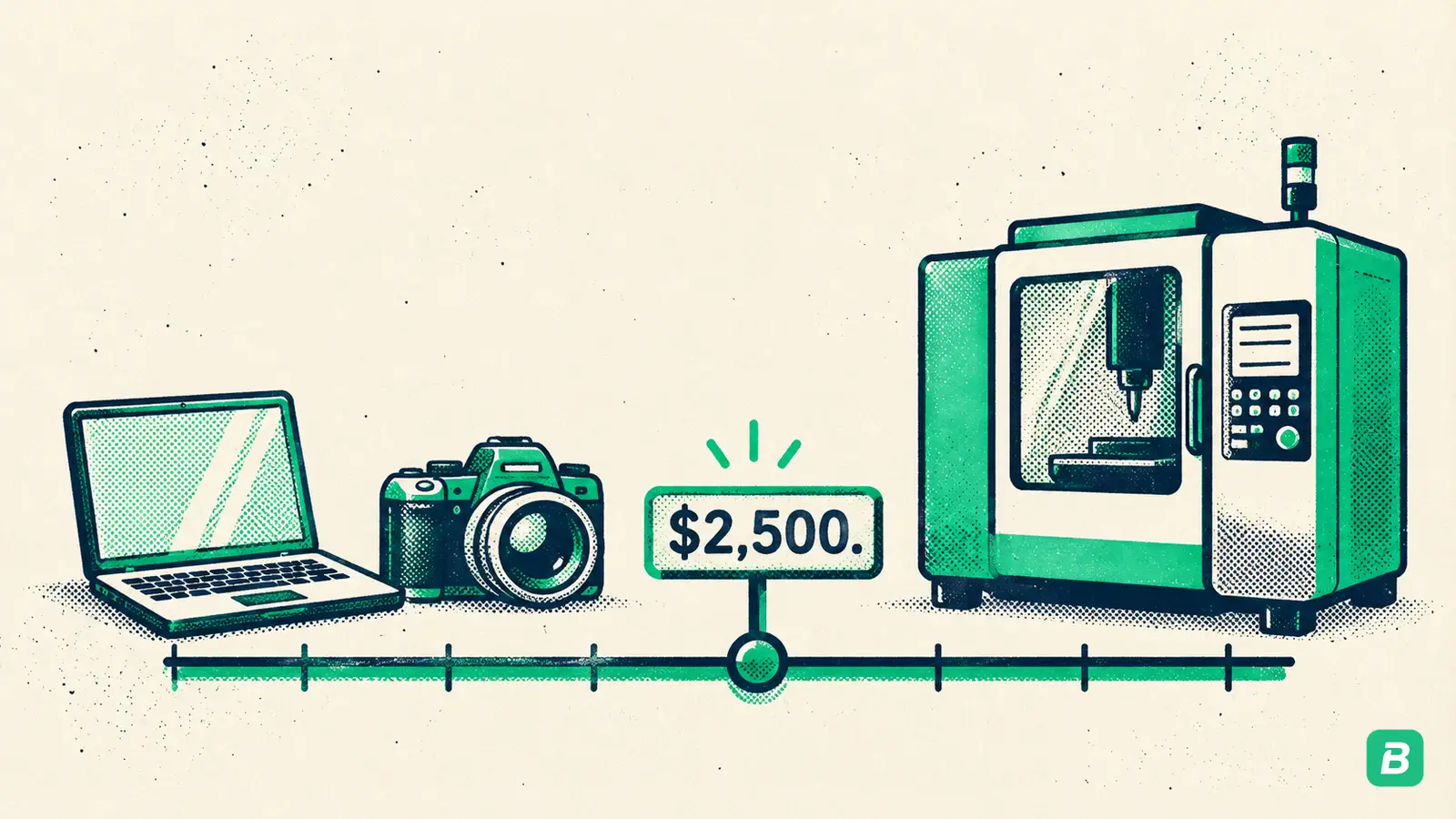
Under the de minimis safe harbor in the Schedule C instructions, you can generally expense tangible property of up to $2,500 per item or invoice as Other expenses, if you make the election. Something above that is depreciated or expensed under section 179 through Form 4562 on line 13. A purchase that is part personal is split by business use.
Software and subscriptions
Software you pay for monthly or yearly to run the business, such as design tools, accounting software or a scheduling app, goes on Other expenses in Part V. The instructions name "subscription services paid to manage your business" as an example.
Deductions That Aren't on Schedule C
Two items 1099 workers often look for are claimed elsewhere on the return:
- Part of your self-employment tax. You can deduct the employer-equivalent portion of self-employment tax when figuring adjusted gross income. It lowers your income tax, not the self-employment tax itself.
- Your own health insurance. It may qualify for the self-employed health insurance deduction, figured on Form 7206 and reported on Schedule 1. It does not go on line 15.
Deductions for Freelancers: Common Mistakes
- Counting the car twice. Claiming the standard mileage rate and also adding gas receipts.
- Commuting miles. Home to your regular office or studio doesn't count.
- Personal spending in the business account. A grocery run on the business card is still personal. Leave it out.
- Entertainment logged as meals. A ticket to a game with a client is entertainment, even if you ate there.
- Club dues. Gym and country club memberships aren't deductible, even if you meet clients there.
- Everyday clothes. Clothes you could wear outside work are generally personal, even if you only wear them to work.
- Old line numbers. Other expenses was line 27a in 2024 and is 27b for 2025. Check the instructions for the year you file.
Records to Keep for Your 1099 Write-Offs
Keep the receipt or invoice for every expense, a mileage log, and any note that explains business use. The IRS generally asks you to keep records for 3 years after you file, longer in some cases, such as unreported income.

Keep your 1099-NEC and 1099-K forms with your own income records too. A 1099-K shows gross payments, before the platform takes its fees. The fees you paid are the write-off, and your own records are how you prove them.
The easiest time to record a write-off is the day you pay for it. A shoebox of receipts in April means guessing at business purpose months later. For a routine that holds up, see the best way to track business expenses. The Schedule C expense categories guide works through a full month of examples.
Let BookZero sort your 1099 write-offs.
Snap a receipt and it suggests the Schedule C category, keeps the photo with the record, and matches it to your bank or card statement.


Want to see how a single receipt reads first? Run it through the free receipt scanner. If you pay for small things in cash, a petty cash log keeps those receipts from going missing.
This guide uses the 2025 Schedule C instructions and the IRS pages linked above, checked on October 21, 2026. Rules change and your situation may differ, so consult a tax professional before you file. BookZero organizes your records; it doesn't prepare or file your return.
Frequently Asked Questions
What can I write off as a 1099 employee?
Strictly, a 1099 worker is an independent contractor, not an employee. You can deduct ordinary and necessary business expenses on Schedule C. Common ones are software, office supplies, the business share of your phone and internet, business mileage or car costs, a home office, contract labor, platform and payment fees, business insurance, travel, and 50% of business meals.
How much can I write off on a 1099?
There is no fixed cap on total write-offs. You can deduct every ordinary and necessary business expense you can document. Some items have their own limits: meals are generally 50%, client gifts $25 per person per year, the simplified home office method 300 square feet, and the de minimis election $2,500 per item or invoice.
Can I write off my car payment as a 1099 contractor?
Not the loan payment itself. With the actual-expense method you deduct depreciation and the business share of loan interest, gas, insurance and repairs. With the standard mileage rate you deduct business miles times the IRS rate, plus business parking and tolls, and the business share of car-loan interest. Either way you need a mileage log.
What is the 2026 mileage rate for 1099 workers?
The IRS business standard mileage rate for 2026 is 72.5 cents per mile for driving from January 1 to June 30, 2026, and 76 cents per mile from July 1, 2026. The 2025 rate was 70 cents per mile.
Do I need receipts for 1099 write-offs?
Yes. Keep a receipt or invoice for each expense, plus a note of the business purpose when it isn't obvious, such as who you met for a meal. For car expenses keep a mileage log. The IRS generally asks you to keep records for three years after you file.
Is my phone bill a 1099 write-off?
The business share is. If you use your phone 60% for work, you can deduct 60% of the bill on Schedule C line 25, Utilities. Keep the bills and a reasonable record of how you worked out the business percentage.
Do write-offs reduce self-employment tax?
Yes. Self-employment tax is figured on your net earnings from self-employment, which is your Schedule C profit after expenses. Every write-off that lowers your Schedule C profit lowers the self-employment tax as well as income tax.

Eric Tech· Founder, BookZero.ai
Founder of BookZero. Building AI-powered bookkeeping tools for US and Canadian freelancers and small businesses.
View all postsStay ahead of tax season
Tax tips, deduction strategies, and feature announcements straight to your inbox. No spam, unsubscribe anytime.