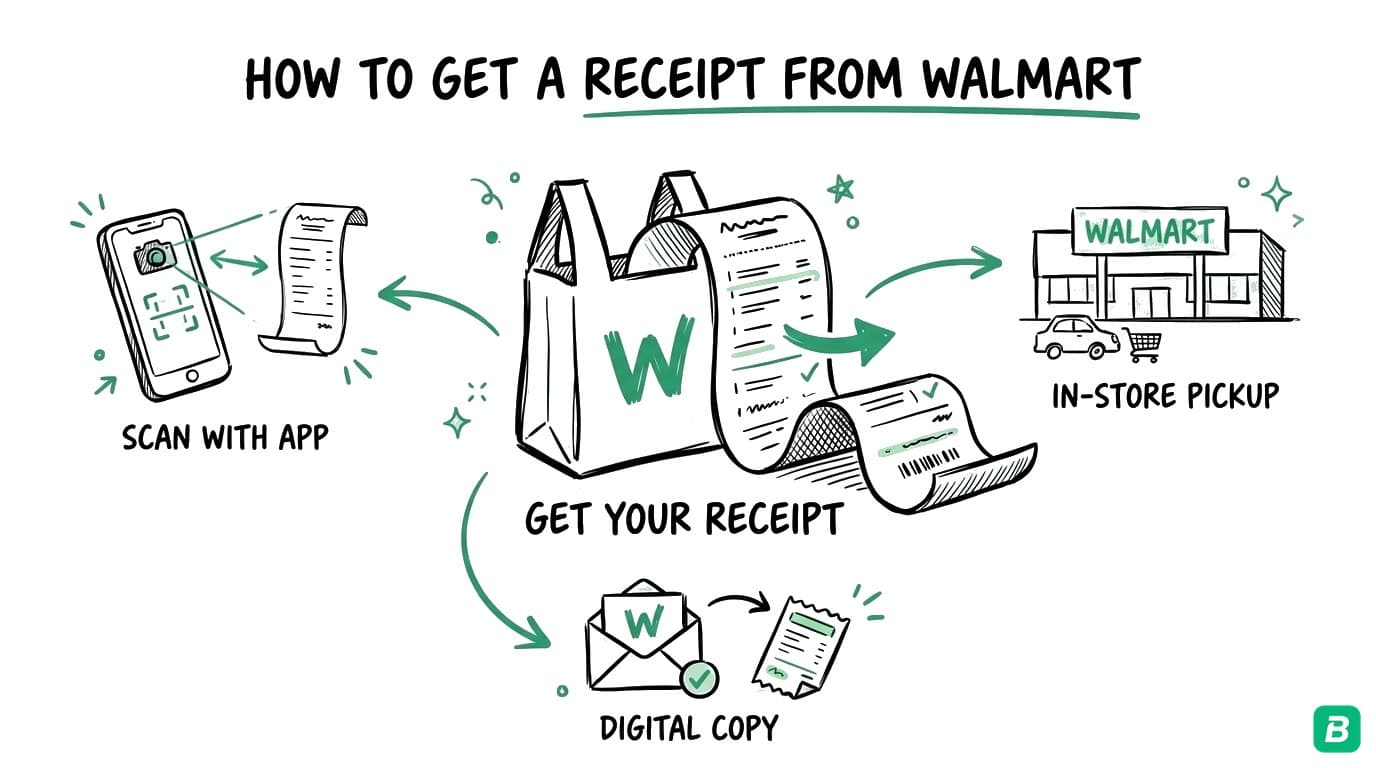
Walmart Receipt Tax Codes Explained: What Tax 1, Tax 2 & Letters Mean (2026)
Decode every letter code and tax line on your Walmart receipt. Learn what Tax 1, Tax 2, Tax 4, and letter codes like F, N, X, and O mean for US and Canadian receipts.
 Eric Tech·Mar 24, 2026·Updated Sep 30, 2026·13 min read·
If you have ever looked at a Walmart receipt and wondered what the letters next to each item mean, or what "Tax 1" and "Tax 2" refer to at the bottom, you are not alone. Walmart uses a system of letter codes and numbered tax lines to show how each item is taxed — and different items on the same receipt can be taxed at different rates.
Understanding these codes matters if you are a small business owner categorizing expenses, filing for tax deductions, or claiming Input Tax Credits on GST/HST. This guide breaks down every code you will see on a Walmart receipt in both the US and Canada.
Tax codes and rates vary by state, province, and municipality. This guide covers the most common codes used at Walmart locations across the US and Canada. Your local store may use slightly different codes depending on local tax regulations. This is not tax advice — consult a tax professional for your specific situation.
How to Read a Walmart Receipt
Before diving into specific codes, here is the basic layout of a Walmart receipt:
- Store header: Store name, address, phone number, and store number
- Line items: Each item you purchased, with the item name, price, and a letter code on the right side
- Subtotal: The pre-tax total of all items
- Tax lines: One or more lines showing "TAX 1," "TAX 2," etc., with amounts
- Total: The final amount you paid
- Payment method: How you paid (card type, cash, etc.)
- TC number: Transaction code at the bottom (useful for returns and receipt lookups)
The letter codes next to each item and the numbered tax lines at the bottom work together. The letter tells you which tax category the item falls into, and the numbered tax lines show the calculated tax for each category.
Walmart Receipt Letter Codes (US)
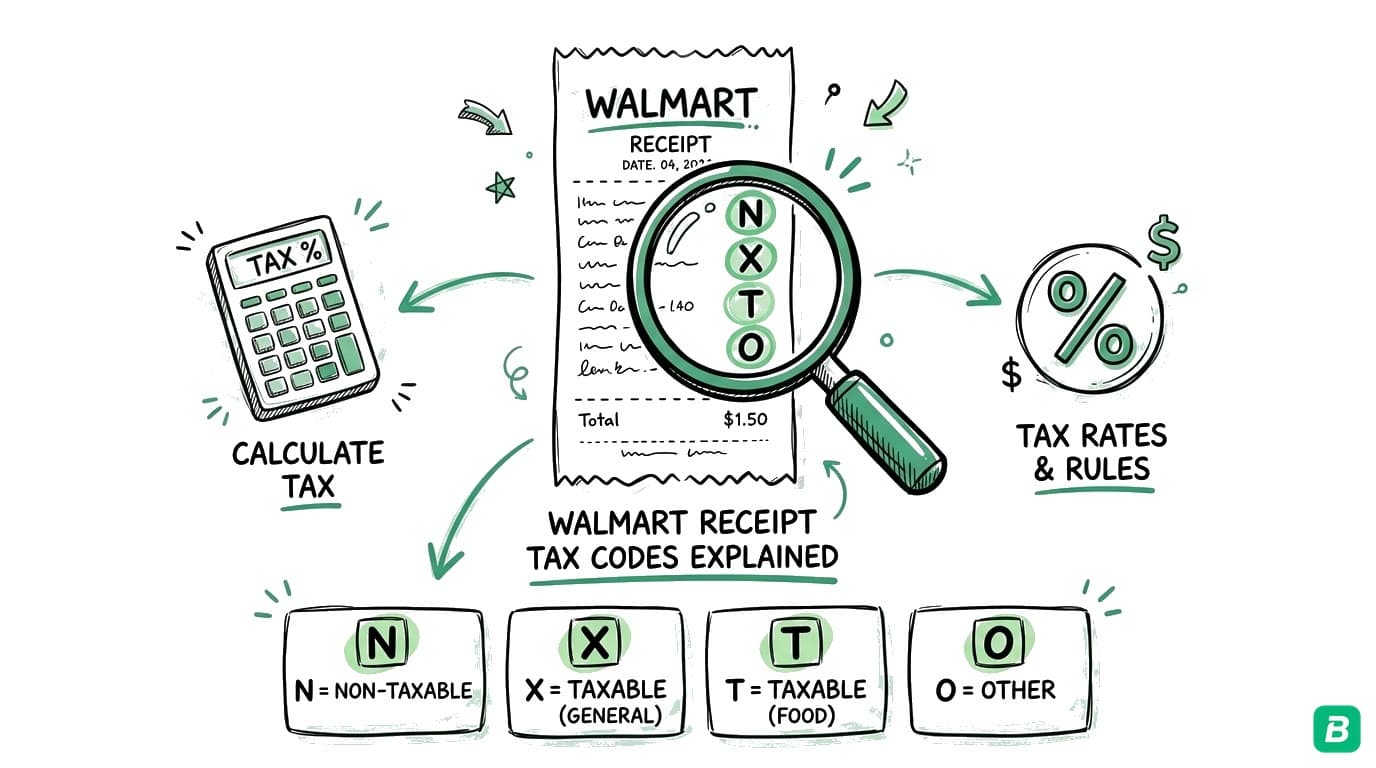
On US Walmart receipts, you will see a single letter to the right of each item's price. Here is what each letter means:
| Code | Meaning | Tax Applied | Example Items |
|---|---|---|---|
| N | Non-taxable | No sales tax | Most grocery food items, prescription medications |
| X | Taxable (standard rate) | State + local sales tax | Electronics, clothing (in most states), household goods |
| O | Taxable (reduced/other rate) | Varies by state | Certain food items, specific categories with different rates |
| F | Food (grocery rate) | Reduced rate or exempt | Groceries in states with a reduced food tax rate |
| P | Pharmacy/prescription | Exempt | Prescription medications |
| T | Taxable | Same as X in most locations | General taxable merchandise |
The codes you will see most often are N (no tax) and X (fully taxed). If your receipt is mostly groceries, most items will show N. If your receipt is mostly household goods or electronics, most items will show X.
Why Different Items Have Different Codes
Sales tax in the US is not one-size-fits-all. Most states exempt or reduce tax on essential groceries but fully tax non-food items. Some states also have special rates for clothing, medications, or prepared foods. Walmart's system assigns the correct tax code to each item based on the store's state and local tax rules.
For example, on a single Walmart receipt in Texas:
- A bag of rice shows N (grocery — no state sales tax on food in Texas)
- A bottle of shampoo shows X (taxable at 8.25% combined state + local rate)
- A 2-liter soda shows N (unprepared food — still non-taxable in Texas)
- A rotisserie chicken shows X in some jurisdictions (prepared food is taxable)
The tax treatment of the same item can differ between states. Soda is tax-exempt in Texas but taxable in many other states. Always check your specific state's rules.
What Tax 1, Tax 2, Tax 3, and Tax 4 Mean
At the bottom of a Walmart receipt, you will see one or more tax lines:
SUBTOTAL                    47.83
  TAX  1    7.250%           1.96
  TAX  2    2.000%           0.22
TOTAL                       50.01
Each numbered tax line represents a different tax jurisdiction or rate:
| Tax Line | Typical Meaning (US) | Common Rate |
|---|---|---|
| TAX 1 | State sales tax | 4% - 7.25% depending on state |
| TAX 2 | County or city sales tax | 0.5% - 3% |
| TAX 3 | Special district tax | 0.1% - 2% |
| TAX 4 | Additional local tax | Varies |
The exact meaning of each numbered tax line depends on your location. In states with simple tax structures (like a flat state rate with no local additions), you may only see TAX 1. In states with layered state, county, city, and district taxes, you might see TAX 1 through TAX 4.
How Tax Lines Relate to Letter Codes
Only items marked with a taxable letter code (X, T, O, or F) contribute to the tax lines. Items marked N are not included in any tax calculation. If all your items are marked N, the tax lines will show $0.00.
Items with different letter codes may be taxed at different rates. For example, in a state with a reduced grocery tax:
- Items marked F (food/grocery rate) might only appear in TAX 1 at a reduced rate
- Items marked X (standard rate) appear in TAX 1 (and TAX 2, 3, 4 if applicable) at the full rate
Tired of hunting for receipts one by one?
BookZero's AI scans any receipt in under 5 seconds — try it free for 7 days.


Walmart Receipt Tax Codes in Canada
Canadian Walmart receipts work differently from US receipts because Canada uses GST, HST, PST, and QST instead of state sales tax. The letter codes and tax lines reflect this different tax structure.
Canadian Letter Codes
| Code | Meaning | Tax Applied | Example Items |
|---|---|---|---|
| F | Food (zero-rated) | No GST/HST | Basic groceries: bread, milk, vegetables, meat, eggs |
| N | Non-taxable / Exempt | No GST/HST | Prescription drugs, certain medical devices |
| X | Fully taxable | GST/HST (or GST + PST) | Electronics, clothing, household goods, cleaning supplies |
| P | PST-only or special provincial | Provincial tax only | Items taxed provincially but not federally (rare) |
| H | HST taxable | HST at provincial rate | Used in some HST provinces to distinguish HST items |
The exact letter codes used on Canadian Walmart receipts can vary by province because the tax structure differs. An Ontario receipt (HST province) may use different codes than a British Columbia receipt (GST + PST province). The table above covers the most common codes — your local store may have slight variations.
Canadian Tax Lines by Province Type
The numbered tax lines on Canadian Walmart receipts depend on which province the store is in.
HST Provinces (Ontario, New Brunswick, Nova Scotia, Newfoundland, PEI):
SUBTOTAL                    35.47
  GST/HST   13.000%          3.12
TOTAL                       38.59
In HST provinces, you typically see a single combined tax line because GST and PST are merged into HST. Ontario charges 13%, while the Atlantic provinces charge 15%.
GST + PST Provinces (British Columbia, Saskatchewan, Manitoba):
SUBTOTAL                    35.47
  GST        5.000%          1.77
  PST        7.000%          2.10
TOTAL                       39.34
In these provinces, GST and PST are shown as separate tax lines. The GST is always 5%. The PST varies: 7% in BC and Manitoba, 6% in Saskatchewan.
Quebec:
SUBTOTAL                    35.47
  GST        5.000%          1.77
  QST        9.975%          1.89
TOTAL                       39.13
Quebec shows GST and QST (Quebec Sales Tax) as separate lines. Note that QST is calculated on the pre-tax amount, not on the GST-inclusive amount (this changed in 2013).
Alberta:
SUBTOTAL                    35.47
  GST        5.000%          1.77
TOTAL                       37.24
Alberta has no provincial sales tax, so you only see the 5% GST line.
How Zero-Rated Items Appear
On a Canadian Walmart receipt, items coded F (basic groceries) are zero-rated for GST/HST. This means:
- The item appears in your item list at its shelf price
- No tax is calculated on it
- It does not contribute to the GST/HST total at the bottom
This is why a grocery-heavy Walmart receipt might show a surprisingly low tax amount — the tax only applies to non-grocery items like cleaning supplies, paper towels, or pet food.
Items That Are Not Basic Groceries
The line between "basic grocery" and "taxable food" catches many people off guard. Here are common Walmart food items and their tax status in Canada:
| Zero-Rated (No Tax) | Fully Taxable |
|---|---|
| Fresh fruits and vegetables | Carbonated drinks and sodas |
| Bread and bakery items (6+ items per package) | Single-serving bakery items (under 6) |
| Milk and dairy | Chips, candy, and snack foods |
| Raw meat, poultry, and fish | Prepared meals and deli items |
| Rice, pasta, and flour | Energy drinks and sports drinks |
| Eggs | Ice cream and frozen desserts |
| Canned goods | Granola bars (less than 6 per package) |
| Baby food and formula | Bottled water (single bottles, varies by province) |
The CRA's rules for what counts as a "basic grocery" versus a "snack" or "prepared food" are detailed and sometimes counterintuitive. The key principle: items sold as staple ingredients for preparing meals at home are generally zero-rated. Items sold as ready-to-eat snacks or beverages are taxable. For the full rules, see our GST/HST guide.
Decoding a Full Receipt: Worked Example
Let's walk through a sample Canadian Walmart receipt (Ontario, 13% HST) to show how all the codes work together:
WALMART #1234 - MISSISSAUGA, ON
GST/HST# 123456789 RT0001

BANANAS 2.47 LB        1.28  F
CHICKEN BREAST          8.99  F
WHOLE WHEAT BREAD       3.49  F
PAPER TOWELS            6.97  X
DISH SOAP               3.47  X
COCA-COLA 2L            2.29  X
AA BATTERIES            9.97  X
BABY FORMULA           28.99  F

SUBTOTAL               65.45
  GST/HST  13.000%      2.95
TOTAL                  68.40
VISA ************1234  68.40
Breaking this down:
- F items (bananas, chicken, bread, baby formula): Total $42.75 — no tax charged
- X items (paper towels, dish soap, Coca-Cola, batteries): Total $22.70 — taxed at 13% HST = $2.95
- The HST applies only to the $22.70 in taxable items, not the full $65.45 subtotal
If you are a business owner and all items were for business use, you could claim an ITC of $2.95 on your GST/HST return. The F-coded items have no tax to recover — but they still count as deductible business expenses on your income tax return if they qualify (for example, food purchased for a business event).
Using Tax Codes for Business Expense Tracking
Understanding Walmart tax codes helps you categorize expenses accurately for your books.
Separate Business from Personal
If a single Walmart receipt includes both business and personal items, use the item descriptions and tax codes to split them. Only claim the business portion as an expense. Document the split — highlight the business items or note them in your bookkeeping software.
Categorize by Tax Code
The tax code can help you quickly sort items into expense categories:
| Tax Code | Likely Business Category | T2125 Line |
|---|---|---|
| X (office supplies) | Office expenses | 8811 |
| X (cleaning products) | Maintenance and repairs | 8960 |
| X (electronics/equipment) | Capital cost allowance | Part 10 |
| F (food for business) | Meals and entertainment (50%) | 8523 |
| X (vehicle supplies) | Motor vehicle expenses | Part 9 |
Verify Tax Amounts for ITC Claims
When claiming Input Tax Credits, cross-check the tax lines on your receipt against the item codes. Make sure:
- The tax percentage matches your province's rate
- Only X-coded items were included in the tax calculation
- The GST/HST registration number is visible on the receipt
If the receipt is unclear or partially faded, request a reprint from the store. The CRA can deny ITC claims that lack proper documentation. For more on organizing receipts for tax time, see our expense tracking guide.
Common Questions About Walmart Tax Codes
Why does my receipt show Tax 1 and Tax 2 but some items show N?
Items marked N are non-taxable — they are not included in any tax calculation. The Tax 1 and Tax 2 lines only apply to items marked with taxable codes (X, T, O, or F with a reduced rate). Even though the N items appear in the subtotal, they contribute $0 to the tax lines.
What does "Tax 4" mean on a Walmart receipt?
Tax 4 typically represents an additional local or special district tax in US locations with multiple tax jurisdictions. For example, some cities or counties levy an extra sales tax on top of the state and county rates. Tax 4 captures this additional layer. Not all receipts will have a Tax 4 line — it depends on the tax structure where the store is located.
Why is the same item taxed at my Walmart but not at another?
Sales tax is location-specific. A Walmart in one state or province may tax an item that is exempt in another. In the US, states like Oregon and Montana have no sales tax at all, while states like Tennessee tax groceries. In Canada, provincial tax rates and rules differ — an item in Alberta (5% GST only) has less tax than the same item in Nova Scotia (15% HST).
Why are some groceries taxed on my Canadian Walmart receipt?
In Canada, "basic groceries" are zero-rated for GST/HST, but not all food qualifies. Prepared meals, carbonated drinks, candy, chips, and single-serving bakery items are fully taxable. The distinction is based on CRA rules about what constitutes a staple food versus a convenience/snack item. Check the F (zero-rated food) versus X (taxable) codes next to each item on your receipt.
How do I know which tax code to use for bookkeeping?
You do not need to record the Walmart letter codes in your books. What matters for bookkeeping is the expense category (office supplies, meals, vehicle, etc.) and the tax amount (for ITC claims). The letter codes help you understand why certain items were taxed differently, which is useful when splitting a receipt between business and personal items or between expense categories.
Stop wasting hours tracking down receipts.
BookZero organizes all your receipts for tax time — start free.

Eric Tech· Founder, BookZero.ai
Founder of BookZero. Building AI-powered bookkeeping tools for US and Canadian freelancers and small businesses.
View all postsStay ahead of tax season
Tax tips, deduction strategies, and feature announcements straight to your inbox. No spam, unsubscribe anytime.