Confirm Receipt: What It Means & Professional Email Examples (2026)
Learn what "confirm receipt" means in business. Includes professional email templates for confirming receipt of documents, payments, and invoices.
 Eric Tech·Mar 24, 2026·14 min read·
What Does "Confirm Receipt" Mean?
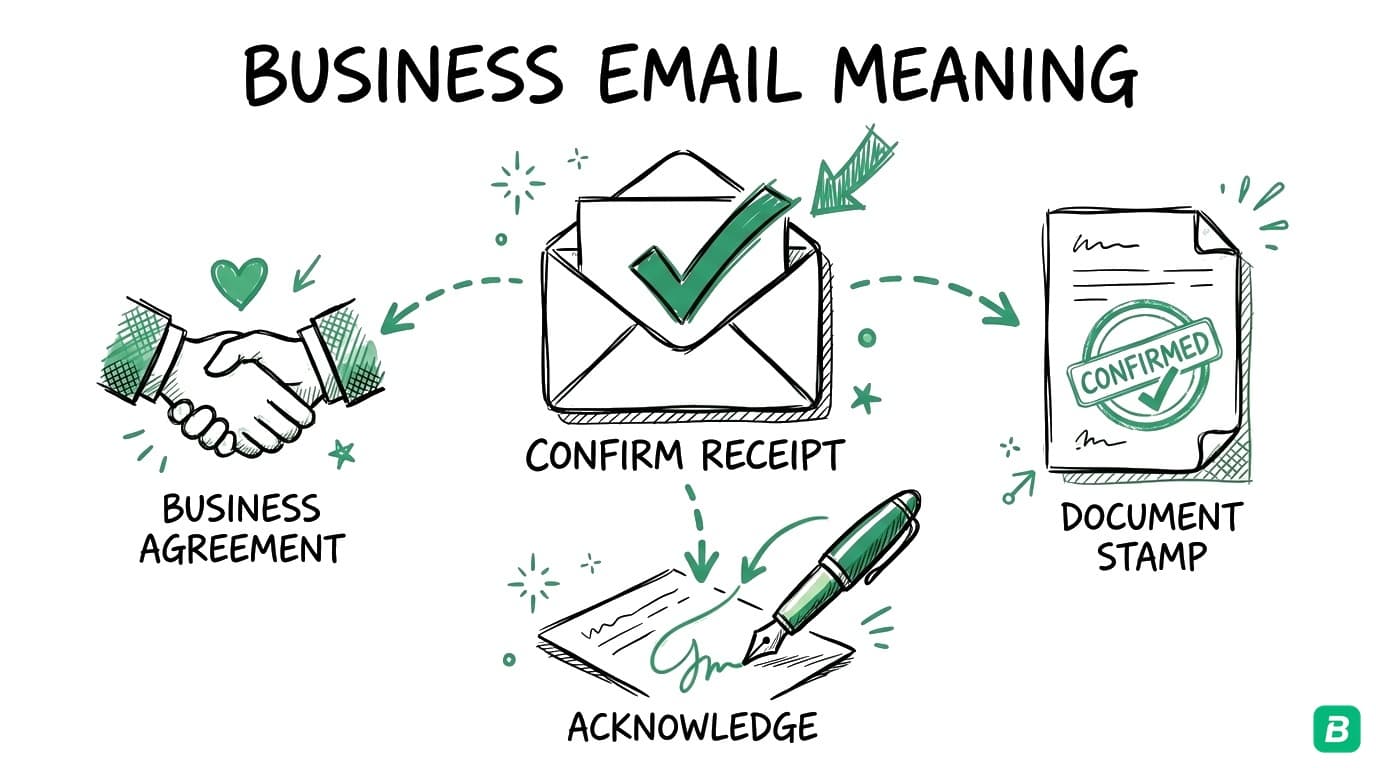
"Confirm receipt" is a business phrase that means acknowledging you have received something — a document, email, payment, package, or file. When someone asks you to "please confirm receipt," they are requesting written verification that the item reached you successfully.

The phrase serves a practical purpose: it creates a documented record that a transfer of information, goods, or money was completed. In business, legal, and financial contexts, this confirmation can prevent disputes, satisfy compliance requirements, and keep projects moving forward.
You will encounter "confirm receipt" in several contexts:
- Email — "Please confirm receipt of this email" means reply to acknowledge you received and read it
- Payments — "Please confirm receipt of payment" means verify the funds arrived in your account
- Documents — "Please confirm receipt of the attached contract" means acknowledge the document reached you
- Shipping — "Confirm receipt of goods" means verify the physical shipment was delivered and inspected
- Legal — Confirmation of receipt can serve as evidence in contract disputes or regulatory compliance
Why Confirming Receipt Matters in Business
Skipping receipt confirmation is one of those small oversights that causes real problems.It prevents miscommunication. Emails get lost in spam folders. Attachments fail to send. Payments bounce. A quick confirmation closes the loop and lets both parties move forward with confidence.

It creates a paper trail. In disputes over whether a contract was delivered, an invoice was sent, or a payment was made, a confirmation email is evidence. Without it, you have one party's word against another's.

It is professional courtesy. When a client sends you a signed contract or a vendor confirms your payment, responding promptly signals reliability. Ignoring confirmation requests signals disorganization — or worse, indifference.
It satisfies compliance requirements. In regulated industries like finance, healthcare, and legal services, confirming receipt of documents is often a procedural requirement, not just good practice.
Professional Email Templates for Confirming Receipt
Here are ready-to-use templates for the most common business scenarios. Adapt the tone and details to your situation.
Template 1: Confirming Receipt of an Email or Document
Subject: Re: [Original Subject Line]
Hi [Name],
Thank you for sending this over. I can confirm I have received the [document name/email/attachment] and will review it by [date].
If I have any questions, I will reach out.
Best regards, [Your Name]
Use this when a colleague, client, or partner sends you a document, report, or important email and asks for confirmation.

Template 2: Confirming Receipt of Payment
Subject: Payment Received — Invoice #[Number]
Hi [Name],
This is to confirm that we have received your payment of [amount] for Invoice #[number], dated [date]. The payment was processed on [date] and your account is now up to date.
Thank you for your prompt payment. Please keep this email for your records.
Best regards, [Your Name]
When confirming payment receipt, reference the specific invoice number, amount, and date. This eliminates ambiguity if the sender has multiple outstanding invoices and creates a clear audit trail for both parties.

Template 3: Confirming Receipt of a Package or Shipment
Subject: Shipment Received — Order #[Number]
Hi [Name],
I am writing to confirm that we received the shipment (Order #[number] / Tracking #[tracking number]) on [date]. All [number] items have been inspected and are in good condition.
[If applicable: We noticed [issue]. Could you advise on next steps?]
Thank you, [Your Name]
For physical goods, always confirm receipt promptly. Many shipping contracts and purchase agreements have inspection windows — if you discover damage after the window closes, you may lose your ability to file a claim.

Template 4: Confirming Receipt of a Signed Contract
Subject: Contract Received — [Project/Agreement Name]
Hi [Name],
I can confirm receipt of the signed [contract/agreement name] dated [date]. I have filed it with our records and [next step — e.g., "will countersign and return a fully executed copy by end of day" or "our team will begin work as outlined in Section 3"].
Please do not hesitate to reach out if you have any questions.
Best regards, [Your Name]
Template 5: Confirming Receipt of an Invoice
Subject: Invoice #[Number] Received
Hi [Name],
Thank you for sending Invoice #[number] for [amount]. I can confirm it has been received and entered into our system. Payment is scheduled for [date] per our [net-30/net-60/agreed] terms.
If there are any discrepancies, I will follow up before the payment date.
Regards, [Your Name]
Template 6: Formal Confirmation of Receipt (Legal or Compliance Context)
Subject: Confirmation of Receipt — [Document Name]
Dear [Name],
This letter serves as formal confirmation that [Company Name] received the following on [date]:
- Document: [Full document name and version]
- Method of delivery: [Email / Courier / Registered mail / Hand delivery]
- Received by: [Your full name and title]
This confirmation does not constitute acceptance, approval, or agreement with the contents of the above document. [Company Name] reserves the right to review and respond in accordance with [applicable agreement/timeline].
Sincerely, [Your Name] [Your Title]
In legal and contract contexts, confirming receipt of a document is different from accepting its terms. If you are confirming receipt of a contract revision, settlement offer, or legal notice, state explicitly that your confirmation is acknowledgment of delivery only — not agreement with the contents.

When to Confirm Receipt (And When It Is Not Necessary)
Not every email requires a reply confirming you received it. Use judgment based on context.

Always confirm receipt when:
- Someone explicitly asks you to ("please confirm receipt")
- You receive a payment, signed contract, or legal document
- The sender needs to know delivery was successful before taking their next step
- You are in a regulated industry where documentation is required
- The communication involves financial transactions or sensitive data
Skip confirmation when:
- The email is informational with no action required (a newsletter, a status update)
- You are in an ongoing thread where your next substantive reply serves as implicit confirmation
- The sender did not request it and the content is routine


"Confirm Receipt" in Different Business Contexts
Email and Digital Communication
In email, "please confirm receipt" is a standard professional request. It is especially common when sending important attachments, contracts, or time-sensitive information. The expected response is a brief reply acknowledging delivery — not a detailed review.
Some email systems offer read receipts, but these are unreliable. Many recipients block automatic read receipts, and they only confirm the email was opened, not that the attachment was downloaded or the content was understood. A direct reply is always more reliable than a read receipt.
Payments and Invoicing
Confirming receipt of payment is standard practice in accounts receivable. It protects both parties: the payer has proof their obligation was met, and the receiver has a record of when funds arrived.
For businesses that process multiple payments daily, automating payment confirmation emails saves significant time. Most invoicing software — including accounting platforms and payment processors — can send automatic confirmations when payments are recorded.
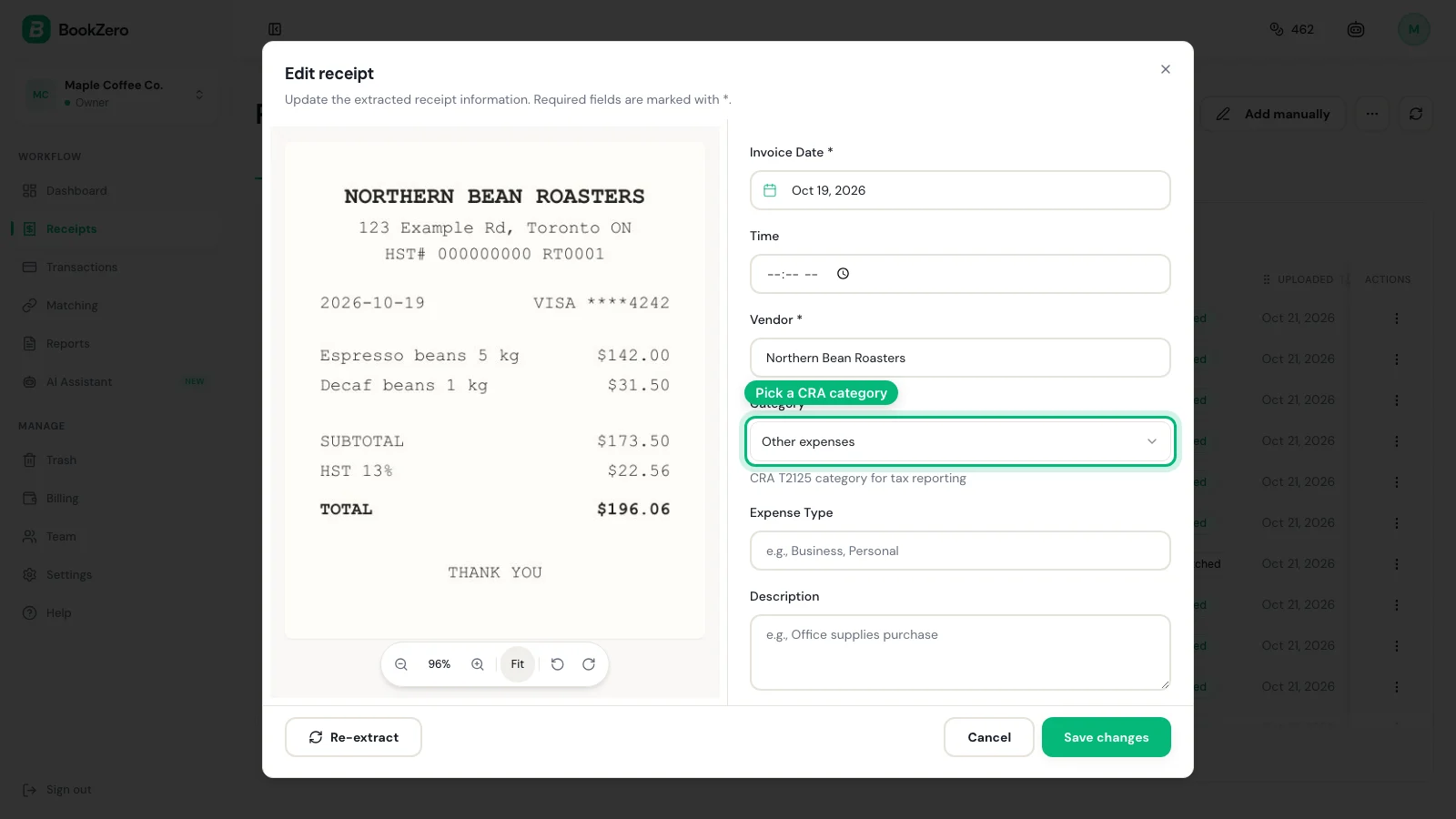
This is where "confirming receipt" in the communication sense connects to managing actual receipts. When a client confirms they received your payment, that confirmation email becomes part of your financial records. And the receipt itself — the proof of what was paid, when, and for what — needs to be stored, categorized, and accessible at tax time.

Shipping and Logistics
In shipping, confirming receipt means verifying that goods were delivered in the expected condition and quantity. This triggers important downstream processes: releasing payment from escrow, starting warranty periods, and closing purchase orders.
Many supply chain agreements include an inspection period — typically 24 to 72 hours after delivery — during which the buyer must confirm receipt or report issues. Missing this window can waive your right to dispute damaged or missing items.
Legal and Compliance
In legal contexts, confirmation of receipt is often a procedural requirement. Court filings, regulatory submissions, and contractual notices frequently require proof of delivery. Registered mail, courier confirmation, and email acknowledgment all serve this purpose.
Some industries — financial services, healthcare, government contracting — require formal receipt confirmation as part of their compliance frameworks. If you operate in a regulated space, check whether your industry has specific requirements for how receipt must be confirmed and documented.
From Confirming Receipts to Managing Them
There is an interesting bridge between the two meanings of "receipt" in business. When someone asks you to confirm receipt of a payment, they are talking about acknowledgment. But the payment receipt itself — the document proving the transaction — is something your business needs to keep, organize, and produce at tax time.
Most small business owners are reasonably good at confirming they received things. Far fewer are organized about storing the receipts that prove those transactions happened.
The CRA requires Canadian businesses to keep receipts and financial records for six years from the end of the last tax year they relate to. The IRS requires records for three to seven years depending on the situation. That is a lot of paper — or a lot of disorganized digital files — if you do not have a system.
Whether it is a receipt for office supplies, a client payment confirmation, or an invoice from a vendor, every financial document needs to be:
- Stored somewhere you can find it
- Categorized by expense type for tax deductions
- Accessible when your accountant or the tax authority asks for it
Canadian Business Context
CRA Record-Keeping Requirements
The CRA is specific about what records Canadian businesses must retain. Under the Income Tax Act, you must keep:
- Sales invoices and receipts
- Purchase invoices and receipts
- Contracts and agreements
- Bank statements and cancelled cheques
- General ledger and journal entries
These records must be kept for six years from the end of the tax year they relate to. If you filed your 2026 return in April 2027, you must keep 2026 records until at least the end of 2033.
The CRA accepts digital copies of receipts and records as long as they are legible, complete, and stored in a format that can be accessed and read. Scanning paper receipts and storing them digitally is perfectly valid — and far more practical than filing cabinets full of fading thermal paper.
Bilingual Business Communication in Canada
In Canadian business, you may need to confirm receipt in both English and French, particularly if you operate in Quebec or deal with federal government agencies.
Common French equivalents:
| English | French |
|---|---|
| Please confirm receipt | Veuillez accuser reception |
| I confirm receipt of your email | J'accuse reception de votre courriel |
| Confirmation of receipt | Accusé de reception |
| We acknowledge receipt of | Nous accusons reception de |
If your business operates in Quebec, the Charter of the French Language requires that commercial communications be available in French. For businesses outside Quebec dealing with federal agencies, bilingual confirmation is professional courtesy and sometimes a procedural requirement.
Receipt Management for Canadian Tax Filing
When you file your T2125 as a self-employed Canadian, you need receipts organized by expense category — advertising, meals and entertainment, office expenses, vehicle costs, and so on. The CRA can request supporting documentation for any line item on your return.
Good receipt management is not just about having the receipts. It is about being able to find the right receipt, for the right expense, in the right category, when someone asks for it. That might be your accountant during tax prep, the CRA during an audit, or yourself when you are reconciling your books.

For a complete overview of how to keep your books in order as a Canadian small business, see our bookkeeping guide.
Frequently Asked Questions
Is "please confirm receipt" formal or informal?
It is a formal business phrase. In casual communication, people say "let me know you got this" or "did you get my email?" In professional, legal, or financial contexts, "please confirm receipt" is the standard phrasing.
What is the difference between "confirm receipt" and "acknowledge receipt"?
They mean the same thing in practice. "Confirm receipt" is more common in everyday business communication. "Acknowledge receipt" is slightly more formal and is preferred in legal documents and official correspondence.
How quickly should I confirm receipt?
Within 24 hours for routine business communication. Immediately — or within a few hours — for time-sensitive documents, payments, or legal notices. If you need more time to review the contents, confirm receipt first and indicate when you will follow up with a substantive response.
Can a read receipt replace a confirmation email?
No. Read receipts only confirm that an email was opened, and many recipients block them. They do not confirm that attachments were received, that the content was understood, or that the recipient intends to act. A direct reply is always more reliable and more professional.
How long do I need to keep payment receipts for tax purposes?
In Canada, the CRA requires you to keep business records and receipts for six years from the end of the last tax year they relate to. In the US, the IRS generally requires three years from the date you filed your return, but this extends to six or seven years in certain situations involving underreported income or unfiled returns. When in doubt, keep records for seven years.

Eric Tech· Founder, BookZero.ai
Founder of BookZero. Building AI-powered bookkeeping tools for US and Canadian freelancers and small businesses.
View all postsStay ahead of tax season
Tax tips, deduction strategies, and feature announcements straight to your inbox. No spam, unsubscribe anytime.